
Explore the latest trends and find our updates on all you need to know about what is happening in the world of web and technology.

 8376
8376
E-commerce together with grocery apps and other vital services are in greater demand today than ever before. It is because of the rise in cases of Coronavirus. As with many other sectors, the COVID-19 pandemic has severely affected the education market. Besides these apps, educational apps are also receiving remarkable feedback.
Universities and schools are switching to virtual classrooms to break the virus transmission chain and ensure the academic year of students is not wasted. Meanwhile, universities and schools which have already invested in the production of education apps remain ahead of the game. And if your institution still runs on the legacy network, then it is the right time to turn to an online platform.

We are going to find out some of the benefits of using e-learning apps for both students and educational institutions. We will also direct you through the process of creating mobile e-learning apps to help your company remain competitive, profitable, and offer the latest features during the Coronavirus outbreak.
E-learning
E-learning is a method that enables users to learn how to use new and emerging technology, including educational applications, services, online channels, podcasts, forums, and other online resources. It makes learning interactive and exciting with full user control as needed.
Importance of using e-learning
The learning app developed is built to offer a solution; that is, to give on-demand learning. But if you have a learning app that has an enjoyable user interface, then this approach is said to be successful. It helps to deliver the content effectively. A straightforward interface lets students concentrate on the content, which is engagingly combined with multiple dimensions.
When your mobile app user subscriber grows during the coronavirus outbreak, the traffic load will eventually impact the results. Your software needs to follow different requirements, including the current versions of the operating systems, security upgrades, and facilitate the introduction of new functionality to ensure the software remains viable and smooth running.
A smooth Internet link cannot be made accessible round the clock, mainly in countries where the Internet bandwidth is not of this standard. The Mobile App design services should, therefore, develop an e-learning framework capable of even working in an offline mode. It will keep the user informed, and they can use the app to enjoy the content whenever possible. Each downloaded module or material will give you a more in-depth insight into how useful the app is for education.

Push Notifications are a good user experience strategy and are not considered spam in comparison to emails and texts, which people feel are annoying. Such alerts are a perfect way to connect directly with users and keep them engaged. Push alerts share information about the new shipment, content to review, and other relevant updates.
Can I see the process of developing my E-Learning app?
Yes, progress reports on the e-learning process are typically provided at an appropriate time. We build your E-Learning app on our Development Server and share all credentials to monitor the rate of progress of your app.
How long does it take for the development of the E-learning app?
The time to produce a mobile app is basically calculated basing on numerous factors such as features, scalability, server hosting, and functionality.
Do you offer maintenance after app deployment?
We are offering extended maintenance plans to our clients. We also fully support the app that we design and develop if it faces any problems or needs any improvements. In addition, our team offers complete maintenance and support of mobile apps.
What is e-learning on the mobile?
Mobile learning, also called m-learning, is a great way to access learning material at any time or place. Learning with mobile device support is more demanding than conventional learning. You can learn wherever you want. Educational systems have significantly changed with the rise of mobile learning.
Are you assuring the device idea of protection and confidentiality?
Yes, we are signing an NDA to protect your idea and information about the app. Therefore we ensure the full protection and privacy of the project for the creation of mobile apps.
The e-learning app development industry has seen a massive surge in recent years, thanks to growing technology. And with the coronavirus threat, there will be a surge in demand for online learning. Educational apps are making the learning process engaging, interesting, and, above all, easy to access. The features and benefits of the above app will surely help you invest in them and give your users valuable stuff to learn better.

 2375
2375
 22 Apr
2020
22 Apr
2020
 5
min read
5
min read
The days of depending upon strangers to ask for directions are gone. Thanks to smartphones and mobile apps such as Google Maps, we now have locations and directions right in our pockets.
Currently, of course, a number of route planning and navigation apps are already available on the market, including Apple Maps and Google Maps. However, to use its software, consumers still need to open the specific app to find the route to their destinations, which is frustrating for end-users.
So, mobile app developers have begun incorporating the route planning functionality right inside their own mobile apps to tackle this problem. Other mobile app start-ups, such as Last-Mile Delivery, incorporate route planning features right in their mobile apps.
In today's post, we'll explore the advantages of incorporating route planning, what kind of app start-ups might benefit from route planning software, what are the main features of an ideal route planning software.
Increasing the number of jobs each driver completes within a day can increase profits significantly. Route planning software can help ensure that the routes of the vehicle are both efficient in terms of the distance traveled and that drivers spend less time on the road reacting to last-minute changes. This will increase customer demand and hire more people to fulfill those businesses.
Route optimization software can help reduce the overall travel time on the road by reducing the miles. And the fewer miles on the road leading to significant cost savings by lower fuel prices: lower miles on the road means lower fuel consumption and therefore lower overall costs.
Minimizing vehicle maintenance costs: Fewer road miles would reduce the need for vehicle maintenance. Vehicles can be used for further journeys. In short, vehicles spend fewer hours in maintenance and more hours in service delivery. Reducing incidents: Less time on the road means less traffic interaction and injuries, which have a positive impact on the insurance of a fleet.
With the route optimization approach, drivers may spend less time planning trips. Such sophisticated route planning solutions reduce the complexity of path requirements, traffic sources and make it easy to find the best routes for each destination.
Businesses not using mobile route planning apps need to allocate a separate budget to keep track of field teams. Yet companies can easily eliminate such communications costs by using route planning.
Route planning software uses an innovative algorithm to give mobile workers the safest and most cost-effective route options.
Drivers who don't manage their time well, take unnecessarily long breaks or refuse to follow the routing plan, which can cost the business money in needless fuel and missing meetings.

But, with the aid of route optimization software, it is easy to examine unproductive drivers and potential revenue loss before they become major trouble. Many companies use software for route optimization to make their fleets more efficient and beneficial. It's a very powerful tool that boasts so many benefits.
Last-Mile Delivery is a costly operation that includes more than 50 percent of total shipping costs. Fortunately, there are many logistics companies worldwide which use route planning software to simplify this process.
Since routing software is using the advanced algorithm, it now provides cost-effective last-mile delivery solutions. It suggests the best and most cost-effective route to distribution workers and reduces the overall shipping costs as a result.
Traditional taxi services have always faced the difficulties of patiently waiting for telephone calls, seeking the exact locations for passengers and so on.
Thanks to smartphones and technology, these taxi companies can now simply build a taxi booking app with smart route planning to find safe and fewer traffic routes. Taxi company owners can boost their business credibility and operational efficiency with route planning.
The transport industry is not a stranger to the rush of on-demand fuel delivery applications and their facilities. You don't need to visit a gas station with fuel delivery apps to get a refill anymore. By buying fuel online you can simply get your tank filled up and get it delivered to your home or on the road.
The location of the customer has now become much faster and easier thanks to route planning software. Even if a consumer is located in a remote area, the delivery of fuel to him is no longer a problem.
Suppose a person visits a new town or world. He or she wants a hotel, in this case, to stay for the night and a nice place to eat nearby. You can let users schedule routes from events to nearby restaurants or hotels, or even to city sites and elite activities for situations such as this.
Our smartphones have become magic wands these days that help us get the required services right at the door. Customers now need food delivery on-demand, beauty products on request, car repair on demand, and so on. All the devices that provide these services usually need to know where customers are to make a delivery. And you can easily solve the transportation problem for your customers by incorporating route planning in your application and providing customer service faster and easier.
While traveling to other cities and countries it can be a great time and money saver to prepare a route to park your car. Parke, one of the top parking apps, helps customers find parking spaces nearby and adds customized routes to that service.
It also saves your vehicle from being towed, as it provides you with the perfect location to park your car. Consequently, a parking system with route optimization saves the user's time and expenses
The framework for route planning plays a very crucial role in healthcare apps. For example, if a patient is so sick that he/she can't travel to the hospital then route planning can help doctors and nurses arrange their test trips in apartments or houses for patients.
It eases their itinerary so they can conduct routine exams smoothly. Combined with route planning, you can also build a healthcare application to improve the overall commuting experience of your users.
With GPS and navigation features also need ways to save favorite routes, places you can conveniently share with family and friends. These are the distinguishing features that can help your app to be the finest planner of delivery routes.
The users may be more fascinated with some places than others when picking places to visit. Suppose a person picks an apartment to rent, for instance; he/she tends to like some options more than others and maybe want to go there first.
Usually, when on a route, users are not always alone: renters go with agents, doctors visit nursing patients and many more. For this reason, users need to share their routes with others through a feature in their app. In addition to the sharing feature, your app should also feature a notification and support system.
 5134
5134
RegTech is a mix of regulatory and technical terms. It is a modern sphere that provides businesses with a range of regulatory services in financial, healthcare, insurance, and other areas.
Thanks to the advent of some advanced technologies that have enabled RegTech to become possible. Organizations have had to manually enforce compliance with RegTech for better functioning of services.
Today, RegTech companies provide services and technology solutions to resolve problems such as regulatory monitoring, data analysis, risk management, identity control, and compliance with regulations.
Increasingly more companies rely on RegTech solutions since 2018. They use advanced regulatory technologies to manage data analysis, risk management, reporting, compliance with regulations and fraud detection.
Modern technologies such as cloud computing, machine learning, biometrics, big data, and the blockchain have used RegTech. Let's look at how RegTech businesses use these technologies.
Using advanced analytics and cloud computing, RegTech companies detect hidden sequences, new trends, unauthorized users, and suspicious activities based on large datasets. Because of the big data implementation in RegTech companies, it has become much easier to control all the data in a single storage.
Machine learning (ML) plays an important role within the RegTech domain. RegTech companies use ML to examine intricate patterns for detecting anomalies across different datasets. Machine learning also helps detect fraud and strengthens risk management
ML systems can also review tax reports and alert businesses about tax issues (helping companies to comply with the law and escape fines), help companies do business abroad, and provide accurate country position complexity (CLC) rankings based on the latest data. Many ML algorithms may even reveal parts of the business environment an organization needs to improve.

RegTech uses biometric data to improve processes for identity management. Biometrics main objective is to control all entities and track suspicious activities. Fingerprint scanning, iris scanning, face scanning, and voice recognition are the most common biometric approaches. Those methods of identification are more convenient and secure than passwords.
On social media channels such as Facebook, Instagram, and Twitter, biometric technologies even enable RegTech companies to bring in new potential customers.
Blockchains have many applications in the RegTech sector. RegTech companies, for example, use blockchains to automate the collection of documents and information. Blockchains allow RegTech companies to validate records immediately, enhance the security of digital signatures and guarantee data security due to the distributed nature of the blockchain.
RegTech companies use cloud computing to provide their products using a distribution model based on software as a service (SaaS). These SaaS solutions help businesses abide by the regulations. Cloud computing reduces hardware and software costs, making data storage more cost-effective for RegTech companies. RegTech companies can use cutting-edge technologies to comply with cloud computing.
RegTech companies can use cloud computing technologies to find any data in just a matter of seconds. All information is kept in a cloud providing data backup and recovery of disasters in case of cyber attacks or human error.
RegTech firms rely heavily on their solutions ' ability to gather, process, and analyze large data sets and even real-time data flows. They use sophisticated analytics tools to send relevant data to customers.
Big data and cognitive analytics enable RegTech solutions to process information in real-time and to produce reports.
RegTech companies make use of the collect, turn, load method to quickly and effectively organize databases.
The software as a service distribution model allows RegTech companies to easily integrate solutions with the organizations ' software systems with which they collaborate.
RegTech helps companies to minimize dramatically the time required to produce reports using standardized and streamlined processes. Such processes do not require human intervention and do away with all human error possibilities.
If clear regulatory details are right, creditors, depositors, and bankers will be able to assess the banks ' financial condition more quickly.

RegTech companies use Know Your Customer (KYC) systems as well as machine learning, artificial intelligence, and biometric technology to identify consumers and possible fraud. The main objective of identity and access management is to ensure that access to specific data or systems is available only to approved users. RegTech offers solutions to handle identity easily and with high security.
The data monitoring is another service offered by RegTech companies. Payment fraud has affected 82 percent of companies in 2018. Efficient tracking of transactions is a potent tool for minimizing fraud and avoiding scams. Big banks are looking into this area because they want the process to be efficient and effective at the end of the day."
Regulatory compliance has always been one of the key objectives of RegtTech firms. RegTech businesses use technology such as automation of robotic systems, machine learning, processing of natural language, biometrics, blockchain, artificial intelligence, and predictive data. They use it to deter money laundering, rising cyber threats, enhance regulatory reporting, and study credit lending apps.
Provide customized services with easy-to-adopt risk identification service models; track real-time to identify potential identity theft and money laundering; analyze suspicious transactions using machine learning and robotic process automation; collect data from various sources; regulate structured and unstructured data.
RegTech companies provide tools and software that not only reduce enforcement costs but also make this process more effective and efficient. In this post, we have clarified RegTech's main features, services offered by RegTech firms, and innovations focused on RegTech.
 2126
2126
31 Mar
2020
4
min read
Marketers that have learned to use location intelligence in customer segmentation, analysis, assignment, and targeting, have greatly improved the performance of their businesses.
53 percent of companies say Location Intelligence is either critical or very important to achieving their 2020 targets. Location Intelligence is offered by leading analytics and platform vendors including Tableau, Alteryx, Microsoft, SAS, Qlik, and TIBCO Software.
Location Intelligence vendors including ESRI, CARTO, Galigeo, Pitney Bowes and MapLarge offering specialized applications and platforms. Product managers need to understand how the application of Location Intelligence will enhance the contextual accuracy of applications and services for marketing, sales and customer service.

Marketers need to look at how they can capitalize on the prolific amount of location data available to smartphones to improve customer advertising, buying and service experiences. This year, R&D, Operations, and Executive Management lead all other departments in adopting and using Location Intelligence.
The industry adoption of Location Intelligence and how user requirements drive capabilities in the industry can have a great impact on the industry. Location intelligence is defined as a form of Business Intelligence (BI), where location or geography is the dominant dimension used for analysis.
With the increase in visualization and the emergence of the Internet of Things (IoT), it has become increasingly important for many businesses to incorporate maps and locations into business analyses. The key insights which offer an excellent perspective on the current location intelligence situation in 2020, include:
R&D leads all departments in the field of data visualization/mapping adoption, reflecting the high level of importance that this use case often plays in whole companies
Certain divisions and functional areas that rely on data visualization/mapping include Accounting, Business Intelligence Competency Center (BICC), and Executive Management. In Advertising & Sales, geomarketing has the most important adoption.

Operations lead all other functional fields in the implementation of logistics management and fleet routing use cases. It has been found that R&D's interest in Location Intelligence, which differs across use cases, may reflect the use of packaged applications as well as select custom creation.
90 percent of government agencies regard Location Intelligence as vital or very essential to their ongoing operations
Healthcare providers have the second-highest number of organizations that critically rate Location Intelligence. The study found that mean levels of importance are similar across organizations in Business Services, Financial Services, Manufacturing, and Consumer Services and further decline among the segments of Technology, Retail / Wholesale, and Higher Education.
Executive management, BICC, and Operations have the highest level of interest in map-based visualizations, which further drive enterprise-wide adoption of location intelligence
Executive management is also leading all others in their involvement in map inclusion and personalized map support in the dashboard. The growing adoption of multiple Location Intelligence use cases by executive management is a factor driving greater adoption across the enterprise. Prioritizing visualization layers on top of charts, offline mapping and data animation on maps are the leading indicators of mapping
Data visualization/mapping dominates all other use cases of Location Intelligence in 2020, with over 70 percent of organizations finding achieving their targets as essential or very significant
The study found that most other use cases have not achieved the visualization & mapping of large adoption data. Despite the lower criticality assigned to the other nine use instances, each shows the potential to streamline an enterprise's viral marketing, sales, and operational areas
Site planning/site selection, geomarketing, territorial management/optimization, and logistics optimization are a secondary level of interest that streamlines supply chains together while making an enterprise easier to buy from. The research team also describes the third level of use cases, led by fleet routing and public services, followed by IoT & smart cities, and indoor mapping.

The research team also describes the third level of use cases led by vehicle routing and public services, followed by IoT & smart cities, indoor mapping, and investment/pricing analysis of real estate. While IoT is over-promoted by vendors, at this time, just over 50 percent of businesses claim the technology isn't important to them.
Four of the top ten features of location intelligence are considered very important/critical for businesses, representing a maturing market
The most popular (counting, quantifying, or grouping) is critical or very important to 46 percent of organizations and at least important to nearly 70 percent. Another indicator of how fast Location Intelligence matures in companies is the advanced nature of analytics features that are used today.
61 percent of organizations state that collaboration with Google is central to their strategies for location intelligence
Google continues to dominate the roadmaps of organizations as the integration of choice for adding more GIS data to Location Intelligence strategies. ESRI is the second choice with 45 percent of organizations calling it a requirement for integration. Database extensions (30 percent) are the next most cited, followed by OpenStreetMap (20 percent).
Map-based visualization, the inclusion of charts in the dashboard and drill-down navigation via map interfaces are the three highest priority features companies are looking for today
Between 64 percent to 67 percent of the leaders interviewed, these three features are considered very important. The next most important features are layered visualizations, multilayer support, and custom region definition. The following graphic provides an overview of the priority features of visualization of Location Intelligence.
 1931
1931
E-commerce has become the industry's most popular method which buyers and sellers both prefer. Nevertheless, as some of you may have already noted, the market landscape is evolving again and soon it will be taking place on a wider scale.
The global exchange has reshaped the online shopping system in a far more competitive and convenient way. The strategy took off in 2016 and has since continued to grow but at a slower pace.
Social media is a completely different world that can be used for any business or anything that may be profitable. Furthermore, for some of us, social media could be a synonym for the internet right now.
The e-commerce method has considerable great influence among internet users. The marketers and brands have therefore integrated social media with e-commerce to start the era of social commerce. So far, though, the initiative is not that great, but it's profitable and has great potential in the time to come.
The term ' Social Commerce' may be an unexplored' term' for you, but trust me that most of you have at some point in your life crossed your paths with this trend. It is a technique for promoting, branding, and eventually selling brands through social media products. This means you can buy the product directly from social media platforms, instead of going to the website of the company. This is a Social networking platform for the majority of users.
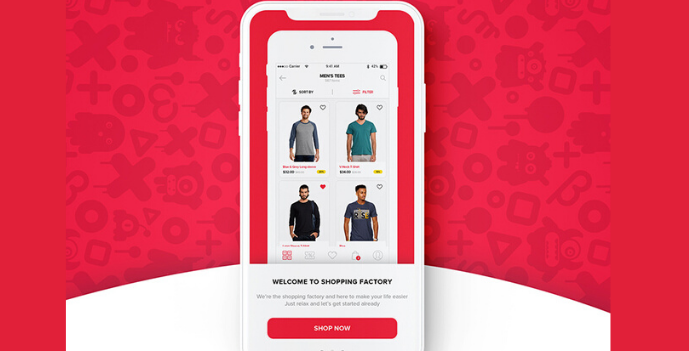
The world of social media is the second largest place filled with people in the whole universe after the physical world (excluding the possibility of a foreigner). In addition, people here in the social media world are more likely to engage with each other.
Social media platforms consume a considerable amount of time in our everyday life, whether it is related to their work or just chilling. This makes it an excellent way and a great opportunity for the brands to hit a large number of potential customers who most of the time are unaware.
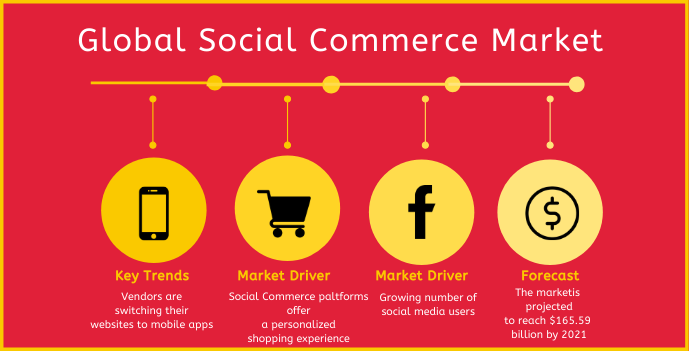
With the right approach, the company will touch millions of users across the globe in no time with its products. Instead of posting the website of your company on Facebook, you can ask users not to leave Facebook to check out the items.
It's definitely a great idea that could change online shopping, or revolutionize it. However, some factors are still restricting it from becoming a big hit. Despite this, the marketing approach has been a long way through and has experienced continuous progress over time.

However, another industry study from Marketing Week reveals that 56 percent of people like to see their goods through the brands on social media. Another 35 percent track brands on social media to determine where they should go shopping next, according to the analysis. So the question that comes up here is whether users are purchasing any product?
The response is no as the study shows that most people are simply searching for some kind of social media information. Moreover, the same study also shows that the millennials have continued to push forward the trend of' Social Commerce.' According to the report, 33% of young people between the ages of 18 and 24 agreed that they would like to make a purchase on Facebook, where 27% goes to Instagram and many more.
The mixed reaction of customers and users of social media makes it difficult to determine if social trading is an emerging phenomenon or just a foolish idea to sell the goods.
Social trading is an innovative approach, despite the web's changing dynamics. People are more in social media than ever and it's the best time for brands to hit. The only reason I believe to keep the vertical is the confidence and loyalty of the users.
Users are still not ready to exit their shell and push Facebook's buy button. Yet, to meet millions of potential users and double your business in no time, there is no great medium than social media. All you need is to figure out how best to make use of this phenomenon for your brands.

Second, you need to consider your target audience, know what they want, and how you can persuade them on social media that it is really you and your brand. Then you have to know exactly what they're looking for and tailor your presentation and goods accordingly. Starting may be slow, but your company will experience a sudden boost once you get your feet secure in social commerce.
We can not ignore the small businesses running on Instagram, individuals running their business over social media specifically. These entrepreneurs earn more than you could expect as users react to their pitch.
 7539
7539
27 Feb
2020
5
min read
An e-commerce company has a variety of metrics to assess and evaluate. To gauge the success of your company, you can look into bounce rates, conversion rates, and CTRs. But the most significant of all is LTV or Lifetime value for the consumer.
App Lifetime Value (LTV) is the average value over an app's lifecycle for an app or a client. It is an important metric and can have several different forms. You can share the app with friends and relatives on sites where your prospects hang out or recommend your app to them.
Revenue can also be drafted in-app advertisements and transactions form. For example, if a consumer does not use the app to spend money but shares it with others who do use it and spend money, it's worth it.
The LTV of your end-users is needed to understand. This will definitely allow you to calculate a marketing campaign's return on investment (ROI) effectively. It is not prudent for advertisers to solely focus on new user acquisition. The acquisition of a new customer costs six or even seven times more than keeping a current one.
There are many different ways of calculating this important metric. The three crucial stats you need are Average order, value Average orders per week (month or year)Weekly (month or year) value you need to take a few clients, decide how much they spend on orders and average over a set amount of time. So add these together to get the total amount of time they spend.

There are different factors that are responsible for the lifetime value of the consumers and one of them is a mobile app. To produce a high investment return (ROI) of your marketing campaigns, you need to increase the users ' lifetime value.
This can be done by increasing the use of the software. There were several approaches known to increase customer LTV. We will cover the methods in this post which will bring success to your e-commerce business.
Your UI design for your mobile app is also a key element in user engagement. If your app makes it difficult for users to access those functions, they'll get annoyed and leave the app immediately. To understand pain points, use analytics and try to create a smooth engaging experience. This will increase the use of your app while increasing the session time.
No matter what strategies you use to maximize the lifetime value of a customer, in the end, the most important thing is product satisfaction. You can be sure of an improved consumer LTV by increasing user satisfaction.
Push Notifications can be quite effective in getting the users interested. If you can get users to accept push notifications, you will have a bigger chance to exploit notifications. This will help in increasing in-app interactions and include inactive users.

Push notifications need to be used smartly though. Although push notifications can improve user experience, being too aggressive with them can do the exact opposite, i.e. deter users from using the application. To maximize the engagement level, it is equally important to ensure that your push notifications are customized.
Keep in mind that the timing and size of the message are significant. Keep the message short, and check with A / B to determine the best timing.
Integrating the user acquisition (UA) strategy with user retention is a successful way to boost LTV from current and potential users of devices. Don't forget to evaluate and refine the mobile advertising campaign with the UA.
For mobile apps, you can launch boost promotions for your e-commerce company to boost app downloads and increase your customers ' LTV. It also reduces the total cost of acquiring consumers and therefore maximizes the sales. For some time, reading and reviewing are important in getting an idea of where you need to spend your campaign budget.
You need to make customer-centric decisions throughout the product lifecycle to achieve a high lifetime value. Make sure you understand the needs and preferences of the users and create an app that will meet their needs.
Provide help on platforms where the prospects hang out. It includes outlets on social media such as Facebook, YouTube, and Twitter. In addition, the implementation of an in-app support program is also a positive means of improving loyalty and user retention.
Deep linking is the method of connecting a URL to a particular page or location within a mobile app. This guides users in a variety of ways to the relevant content including alerts, SMS, email, and social media. It also lets users achieve their goals much quicker.
Consider, for instance, a consumer in some area seeking a particular type of restaurant or hotel. They will be guided through a deeply connected ad inside the app. The search will directly take the user to the intended result, even if it is not enabled, via the app.

Deep linking enables users to witness the effectiveness of an app before it even gets installed. This increases the likelihood of installing your app and may improve a user's lifetime value.
This is actually an essential way to boost user engagement and increase their lifetime value. You need to keep in touch with them on different platforms and enable them to provide input on your goods and services.
Social media is a great place to connect with current and prospective customers and increasing their faith in your brand. Do not forget to use these networks with a real-time strategy, because of the response time on social media matters. Furthermore, these sites provide various ways to spread the word about your product and increase your customer base.
As you try to acquire new users and hoping to create a long-term commitment, the onboarding experience has to be engaging and sticky. You have to personalize the user's experience and provide them with what they need.
Customers with useless information may be inefficient for your app company and e-commerce. Optimizing the method of onboarding users require thorough research and testing. It is here that A / B research can be very useful.
You'll need to test various flows and see which ones appeal to your users the most. To improve customer retention, you must first inspire them and continue to do so throughout their use.
Commerce companies need to create user engagement and retention oriented app. Although acquiring users is critical, optimizing revenue isn't a cost-effective way. A mobile app can be an effective tool for giving your e-commerce business value.
 2057
2057
There's a lot of buzz about next-generation tech, and how it's infiltrating horizontally and revolutionizing the way we're working across the board. Some of this buzz has some validity, especially for AI, Blockchain, and Progressive Web Apps. We demystify Blockchain, AI Tech, and Progressive Web Apps (PWAs) in this article and explore how they will evolve.
A focus shift from conversational AI to predictive AI will occur as we identify opportunities for more polished workflows and user experiences. PWAs are the middle ground between two very different user experiences and their best functionalities melting pot. We now know that Blockchain technology is applicable wherever privacy concerns are raised and where anonymity is required.
You have undoubtedly heard of Blockchain's impermeable ledger and how it threatens the boundaries of traditional banking or contemplates how artificial intelligence can re-imagine predictive management and improve customer interactions. Still, there's a residual uncertainty regarding their capacity for implementation.
I know we often question ourselves, is Blockchain a rogue wave that will settle early, or will decentralized banking render intermediaries obsolete in the next decade? Is PWA the future, or a sideshow in the world of frenetic application development?

We want to get ahead of the Year noise and check in on the three developments in software development that we can not overlook, describing why these next-generation innovations matter and creating a business case around their evolution through data-driven analysis.
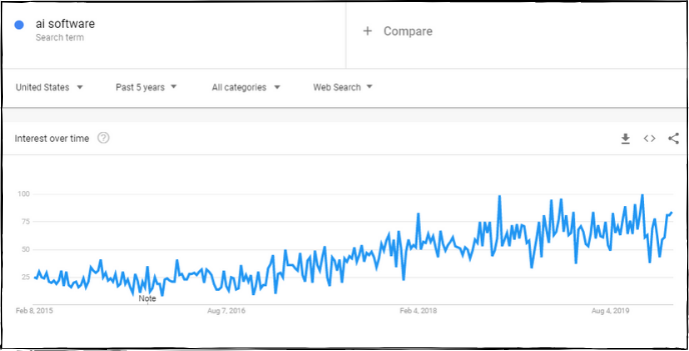
So, to get some answers and understand the buzz surrounding the Blockchain, AI Software, and even Progressive Web Apps (PWAs), we visited Google Trends and looked at how these keywords ' search volumes have ebbed and flowed over the past five years, and what their search volume patterns indicate for this Year.
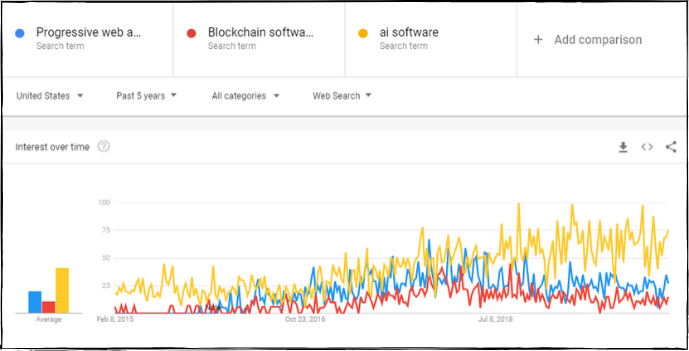
Google Trends indicates a steady increase in the search volume over the five-year period for all three terms. There is no sign that the growing interest is not going to continue into the coming year. We can see that starting in the summer of the other Year, the search volume has started to grow more aggressively and has continued on this pattern since.
The word, AI software, has the most promising trend of search volume of the three, with innovative web apps trailing by a significant margin in second. Now that a rising user base has validated all three innovations let's discuss them individually.
When the Bitcoin boom started, and the bull market ended, it's pretty clear. December 2018 was an anomaly that Bitcoin probably wouldn't experience again. The market has stabilized at this point and begun to ripen. Although this is tragic news for Bitcoin holders, Blockchain is great news.
The unpredictability we have come to associate with the Blockchain forced cryptocurrencies out of the Bitcoin bubble and into the real world. It's done a pretty decent job of living alone, untethered by the mothership. By January 2018, Blockchain pioneers were forced to consider Blockchain in non-peer-to-peer transaction settings, taking into account the quiet capabilities of a centralized operation.

Blockchain's birth coincided with growing interconnectivity and concerns as to how new transparency would compromise the data. Blockchain is an impermeable, decentralized ledger offering an alternative to centralized processes. Once a transaction's parameters are coded, and a new block is created, the transaction will self-execute the parameters accordingly.
So we first look at the obvious application, the banking application. Also, payment powerhouses such as Visa suffer outages in operations. When Person A transacts with Person B via Visa and Visa does not transmit information to Person B. Otherwise, Person A is forced to wait for the recovery of the outage and postpone payment. A minimal number of actors manage a huge amount of money.
In the hands of payment networks, foreign exchanges are particularly vulnerable. International transactions typically take 3-5 days to settle and come with a high cost per transaction. Blockchain alternatives like Ripple and Tron boast that the fees are greatly reduced, and transactions checked in less than half the time.

We may recognize serious data security lapses and reverse the anxiety caused by them. We may be able to apply Blockchain to the voting process, cutting out seedy security protocol software. How if we are turning Real Estate into a completely independent operation, buying and selling homes without a broker, and checking sales and payments across the Blockchain network?
Even cloud computing and Blockchain juxtapose nicely with cryptographic record-keeping, curtailing porous protocols. Mostly, we now know that Blockchain technology is applicable wherever privacy concerns occur, and whenever anonymity is needed
We have attached the screenshot to help direct you towards the general trend that we see for AI Technology. We know that there's a very high likelihood that AI will continue to ascend. We attribute that to an increasing understanding of how artificial intelligence can horizontally integrate. We have unjustly held AI captive in incredibly annoying ways, chatbots, and Siri-like.
Yes, AI software will interpret and respond to natural language patterns. Yes, after analyzing a series of inputs, AI software is trained to formulate and contextualize outputs, but no, the AI is not actually a human-replacement for impromptu conjecture and critical thinking. AI is an excellent wine like it's just getting better with age.
AI is the super-employee, the employee who assumes the burden of continuous learning and personal development outside working hours. Yet, using the same analogy, it will never be possible for this employee to respond with nonverbal communication, build intrapersonal intelligence, or act on visual indications. So as we move to a New Year, we are going to experience a paradigm shift in AI.
As we identify opportunities for more polished workflows and user experiences, there will also be a shift in the focus from conversational AI to predictive AI. Predictive AI transcends vertical, shape-shifting to alleviate a variety of pain points that we didn't identify as pain points up to the time when we had the means to break them down.
Sometimes it's hard to contextualize trends and apply them to your business. We're getting it. Knowing this, next-generation technologies are fun to read about, but it's pretty much useless (if we're honest) without applying the information. So take out of Purgatory your current software solutions and build a bridge to the enlightened side
Blockchain, Artificial Intelligence, and Progressive Web Applications' best part are that they are not limited to verticals; they are horizontal. Chances are one of them that could make your life drastically better and live that you bleed into using whatever service or product you provide. Luckily we're both masters for you.
What is an advanced Web application? We would wind up creating a Progressive Web App (PWA) if we were to mix traditional web application DNA and mobile app DNA in equal proportions. PWAs are the middle ground between two very different experiences with users and a melting pot of their best features.
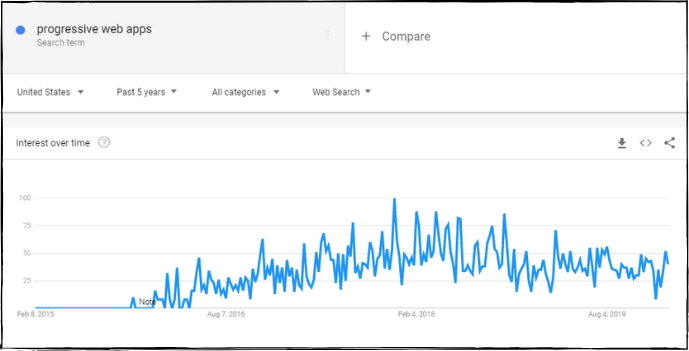
We can see some pretty good growth in the amount of PWA quest, which we described with the green line. What is a progressive web app? We would wind up producing a Progressive Web App (PWA) if we were to bring together traditional web application DNA and mobile app DNA in equal proportions. PWAs are the middle ground between two very different experiences with users.

Users must visit the app store to use mobile apps, download the app, wait for the download, and interact with the application through the thumbnail that appears on their screen. Brands sometimes may lose engagement on the mobile app front due to navigation limitations, load-speed, and an interrupted user journey.
 4338
4338
A great start-up is often involved in many tasks such as product development preparation and much more important aspects. Thus, taking time out of these critical tasks is challenging and devoting it to selecting the right programming language for the business application is very important.
For example, a market needs to keep app protection, development costs, and a variety of other important things in mind. Python is the best option for all these purposes and many others. As a popular and well-established framework, Python facilitates a better functioning to a very large extent from all these issues and offers many business advantages.

Python is not limited to that, in fact, because it also provides independence for future upgrades. Python's popular websites include Stackoverflow.com, Digg.com, Wish.com, and Ubuntu.com.
Big names like Instagram and Facebook also rely on Python to a large extent. Websites still use Python as their programming language and are still considered one of the top 10 programming languages.
This is Python's best part. That it is free and that it will still be available at no cost in the future. By free we mean that its expansion set is absolutely free to support libraries, modules, and tools. Several of its prominent IDEs are available for free download.
Python architecture provides object-oriented design, enhanced process control functionality, unit testing system, and good integration with the capabilities of text processing. This helps in increasing their performance and speed. Therefore, Python is a wise choice for designing complex multi-protocol network applications.
We are currently living in the era of the Internet of Things and it opened up a wave of opportunities for the programmers of Python. Platforms such as Raspberry Pi allow developers to easily build their own devices using Python, such as cameras, phones, radios, and games. The developers will be able to connect with the real-world markets by using the advanced concept in Python development independently and at a minimum cost build their own exiting devices
It is crucial for a company, particularly start-ups, to thrive, to survive, and to make the most of it as long as it lasts. Yet to make sure the company is able to handle this growth quickly. And here Python is doing a fine job. With it, a business will face and will grow constantly, mostly all kinds of challenges and obstacles on its way.
Python is not only favored by the outsiders in the field as a programming language, but even the big fish in the sea, such as Facebook, Quora, and even Google, rely heavily on the code written in Python. Python's creative and flexible quality helps companies to take their products to new levels.
Python is the primary language used by several Blue chip sites and services as well as the reason for its scale efficiency. Whether it's PayPal, Instagram, YouTube, Dropbox, Disqus, Yelp, eBay, etc., Python uses web development. Therefore, by learning the programming language of Python and its advanced frameworks, such as Django development, programmers can find work easily.
Currently, only a few open-source communities are as committed and robust as Python. Full support is available in the event of any type of difficulty in the development of Python. Every day, millions of developers work to improve Python's core functionality.
Python is recognized in the software community as an easy-to-use, intuitive programming language, making it user-friendly. Python includes built-in dictionary data structures that are useful in the development of Python's fast runtime data structures.
At the same time, the platform offers the opportunity for high-level dynamic data typing, reducing the length of the support code required. Therefore, this tends to be the main reason that many start-ups and businesses like Python.
Whether it's YouTube or Reddit, or others, Python is basically used everywhere. It's constantly rising, and hence the language support is also growing. Therefore, to ensure a secure future, it would be a wise move to pick Python as a language.
For businesses with a limited budget, Python makes the best choice. Yes, even for larger projects, it is a good choice. In this language, many companies and businesses tend to build because it allows for rapid development, requiring less coding alongside C++, Java, PHP, and others.
Businesses are mostly web-based, such as media streaming projects or social networks. And usually a huge amount of data powers the internet. It ensures the storage is complex and difficult. But because Python is well-equipped to handle such issues, it is also the best choice in this regard.
There's a reason why Python is the first choice for Google. The reason is that most of Google's tools and features are developed using Python. In fact, for Google's cloud services and Google apps, Python is the safest and best option for optimal integration capabilities.
Facebook
 Production engineers of Facebook give Python great preference, making it the third most prominent language used in this biggie social media, after C++ and its proprietary PHP dialect, Hack). There are many contributions to Facebook facilities and services where they handle software, network imagery, functional delivery, and equipment.

Python has been funded by Google since its creation. C++ was therefore used in cases where memory management was necessary and aimed at low latency. In other aspects, the simplicity of maintenance and substantially best delivery came with Python.
Spotify
 Spotify, a big name in the music streaming arena, is a huge supporter of Python, where it primarily uses the language for data analysis and backend services. Many services talk over 0MQ or ZeroMQ on their backend.
 A few years back, Instagram's engineering team averaged that they were running the world's largest web framework deployment of Django that was entirely written in Python. Even today this is considered to be true. Instagram uses the python language in running its operations.