
Explore the latest trends and find our updates on all you need to know about what is happening in the world of web and technology.

 2353
2353
In the digital age, cyber security has become an increasingly important issue as more and more of our personal and professional lives are conducted online. Cyber security refers to the measures taken to protect computer systems, networks, and sensitive data from unauthorized access or attacks. In this blog post, we will explore the evolution of cyber security from its early days to the present, and what the future holds.
The concept of cyber security emerged in the 1960s when computers were first being used for military and government purposes. The earliest computer security measures involved physical locks and keys to prevent unauthorized access to computer systems. As computers became more advanced, so did the threats against them. In the 1980s, the first computer viruses and worms emerged, which spread through networks and caused damage to computer systems. This led to the emergence of antivirus software to protect against such threats. Governments also got involved in cyber security, with the U.S. Department of Defense establishing the first computer emergency response team (CERT) in 1988.
Today, cyber security threats have become more sophisticated and widespread than ever before. Cyber criminals use various tactics to gain access to networks and steal sensitive data, such as phishing scams, malware, and ransomware attacks. In response, modern cyber security technologies and practices have evolved to keep up with these threats. These include firewalls, intrusion detection systems, encryption, and multi-factor authentication. Both the private sector and government agencies have also taken steps to improve cyber security, with companies hiring dedicated cyber security teams and governments passing laws to protect consumer data.
However, despite these efforts, there are still challenges and limitations to current cyber security measures. Cyber criminals continue to find new ways to exploit vulnerabilities in networks and software, and there is a shortage of skilled cyber security professionals to combat these threats.
As technology continues to advance, so too will the threats to cyber security. Emerging cyber security threats include AI-powered attacks, quantum computing, and attacks on the Internet of Things (IoT). However, new technologies are also being developed to address these threats, such as AI-powered cyber security tools and blockchain technology for secure data storage. Governments are also developing policies and regulations to ensure better cyber security standards across industries.
In conclusion, the evolution of cyber security has been a long and ongoing process as technology continues to advance and cyber criminals become more sophisticated. While current cyber security measures have made significant progress in protecting networks and sensitive data, there is still much work to be done to combat emerging threats. As we move forward into the future, it is crucial that we continue to develop new technologies and best practices to ensure that our digital lives remain secure.

 5797
5797
Cybersecurity is a critical issue for both home and business owners. With the increasing use of technology in our daily lives, it's important to be aware of the risks and take the necessary steps to protect your devices and information. Here are ten must-know cybersecurity tips to help keep your home and business safe from cyber threats:
Create strong, unique passwords for each of your online accounts, and use a password manager to keep track of them.
Regularly update your operating system, software, and security programs to ensure that you have the latest security patches and fixes.
Two-factor authentication adds an extra layer of security to your online accounts by requiring you to enter a code sent to your phone or email in addition to your password.
Don't click on links or download attachments from emails from unknown or suspicious sources.
Regularly back up your important data and store it in a secure location, such as an external hard drive or cloud service.
Install and regularly update anti-virus software to protect your devices from malware and viruses.
Be careful when using public Wi-Fi, as it can be a prime target for cyber attackers. Avoid accessing sensitive information and use a virtual private network (VPN) if possible.
Secure your devices with passwords and encryption, and be mindful of the information you store on them.
Stay informed about the latest cybersecurity threats and educate yourself and your employees on best practices to stay safe online.
Cybersecurity is an ongoing process. Stay vigilant and regularly review your security measures to ensure that you're protected from the latest threats.
By following these ten tips, you can help protect yourself, your home, and your business from the risks of cyber threats. Cybersecurity is an ever-evolving field, so it's important to stay informed and keep your security measures up to date.
 7907
7907
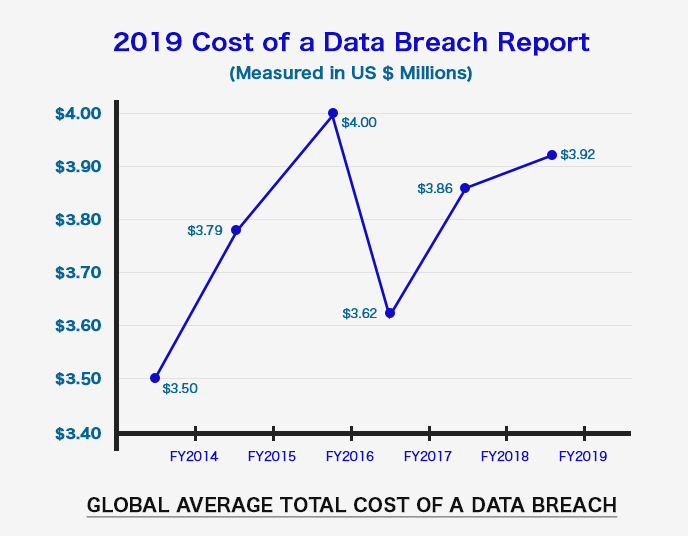
Data breach via unauthorized access has inflicted a revenue damage of nearly $3.86 million to the financial condition of companies worldwide. In similar context, the year-wise global average cost of data breach was reportedly about $3.62 in 2017, $3.86 in 2018, and $3.92 in 2019.
The degree of vulnerability to data breach depends largely upon the attack surface that targets the parts of system defenselessly exposed to unamortized users. The point is, we risk vulnerability of data breach because of unawareness of the loopholes lying unattended in the security system.
Therefore, knowledge about any such vulnerability that a defenseless data system poses is the first step to devise some of the corrective measures to neutralize data breach attempts made by malicious spyware.
One of such measures requires deployment of threat intelligence system. The working method of this system is to mitigate the possibility of hacking to a data system and help you conceive informed decisions regarding how to roll out reinforcement measures for securing crucial data. A common understanding behind data vulnerability is the harmful spyware appearing as friendly in the host system.
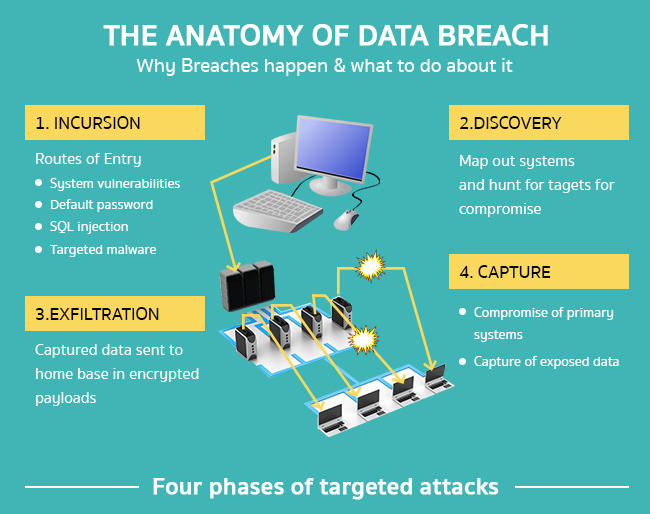
If we study the anatomy of data breach, we conclude that it is attempted as driven by different motives, as explained in the following image.
A form of cyber-attack known as Remote Code Execution (RCE) enables the hacker to remotely access your device while the malicious programs assume absolute control of your compromised device.
With countless varieties of malignant spyware emerging in a new avatar, the threat to data security on Cloud or in analog systems looms large more than ever.
And Pegasus spyware is the most lingering threat to a data breach in today's highly connected digital world. You will be surprised to know that the modus-operandi of Pegasus is based on the RCE pattern of launching a pernicious attack on vulnerable systems.
An Israeli technology firm known as NSO Group Technologies (NSO) developed Pegasus spyware that one can install on any smartphone running on iOS and Android platforms. The far-reaching danger of this spyware lies in its capability of exploiting all the latest iOS versions, a data breach of great precision.
Imagine the gravity of damage it could render on data privacy of a user's information saved in devices like PC, phones, tablets, and other digitally connected gadgets, once the spyware penetrates the system.
Pegasus is programmatically designed to-
The name Pegasus given to this spyware is originated from a Greek mythological character of the same name. So, basically, it is a Trojan horse computer virus capable of infecting cell phones and compromising their crucial data.
In 2016, Ahmed Mansoor, an Arab human rights defender, received a text message, prompting him to follow a link containing some 'secrets' about torturing of prisoners in the UAE's prisons. Doubtful of the nature of the link, he sent it to the Citizen Lab for investigation and thence it was revealed as a malicious attack masquerading as friendly link in the device of Mansoor.
The team of Citizen Lab, in collaboration with the US-based Lookout, Inc. concluded that the spyware would have jailbroken Mansoor's phone had he opened the link, as doing so would have triggered implantation of the spyware in his phone.
Eventually, the lab reported that the dangerous cyber-attack was linked to the NSO Group.
The presence of Pegasus in India was first reported by The Wire declaring that the phone numbers of more than 40 Indian journalists were on a hacking list of an anonymous agency using Pegasus.
The point is, the use of Pegasus is worldwide and is under the radar for being the "most sophisticated" spyware attack ever on phones.
Pegasus is undoubtedly a rising global threat in an era where data security of people and corporate entities is of paramount importance. The reason Pegasus is a global threat to data privacy is because of seamless working capacity of the spyware qualifying it to become relatively more dangerous than other spyware breaching the data security system of phones.
For instance, with Pegasus spyware, you can remotely and covertly extract data from virtually any mobile devices and of course it rules out any interaction by the target, as it features zero-click installations achievable in different ways, including the over-the-air (OTA) option to infect the recipient device with the spyware.
Although the main victim of Pegasus has been iPhones by targeting Apple's default iMessage app and the Push Notification Service (APNs) protocol, yet its android version is also dangerous and can breach the data of a user's smartphone by impersonating an app downloaded to it and then transmitting itself as push notifications via the device's servers.
Considering the long sordid history of malicious spyware attacks that continue uninterrupted, it's high time certain preventive measures brought in place to ensure security of your data. And its imperative, considering a sophisticated piece of spyware like Pegasus inflict against pernicious pattern of targeted surveillance using zero-day exploits in which the basic operation security of victim device come under absolute control of the spyware.
Data breach through malicious spyware attacks has caused enormous revenue loss to companies from around the world, along with compromising their precious confidential data. Pegasus is the most sophisticated spyware being weaponized by hackers to target defenseless security systems of corporate entities and vulnerable devices of individual users.
Under such circumstances, maintaining tangible steps can help you evade the attack of even a sophisticated piece of spyware like Pegasus from getting your devices infected.
Though the lack of fail-safe measures augments the chance for data breach of your business and devices, adopting proactive measures as suggested above are at least better than resorting to the defeatist views that we are defenseless to Pegasus.
As of now, Pegasus spyware certainly assumes a lingering threat to the data breach with serious consequences, including corruption of database and leaking of private information or theft of intellectual property of businesses.
 6419
6419
Ragnarok is a ransomware gang that came into spotlights when they penetrated unpatched Citrix ADC servers and caused mayhem among the victim organizations. It also launched an attack against Sophos Firewall devices.
The term "ransomware" here stands for a malware or malicious software that employs encryption by infecting a host computer thereby paralyzing users' access to it until a ransom is paid to unlock the hacked system.
The basic working mechanism of Ragnarok is to penetrate a vulnerable target and for this, it uses a variety of exploits. Once the system is breached and the ransomware controls its internal network, the resulting effect of encrypting servers and workstations of the hacked system starts to happen.
Eventually, the ransomware steals the files and threatens the victims to leak confidential data until they pay a ransom. The victim organizations have either to refuse the ransom and see their sensitive data leaked on the web portal or pay the money as a saving grace.
The infamous Ragnarok ransomware cybercriminals appear to have shut down its operations and embraced retirement followed by the release of a universal decryption key for its past victims whose firms were located in Hong Kong, Spain, France, Estonia, Sri Lanka, Turkey, Thailand, the US, Malaysia, and Italy.
In fact, the victims of Ragnarok gang were spread across numerous industries ranging from legal services to manufacturing companies.
Most of the leading sources have claimed that the Ragnarok group abruptly terminated its operations and released the tools for the victim organizations to unlock the encrypted files.
First of all, Ragnarok ransomware spreads through phishing emails containing malicious attachments. It may also come through drive-by downloading when a user unintentionally visits a malware-infected website, download the malware and install into the system. When Ragnarok ransomware attacks a system and makes it infected, the victim gets an intimidating message on the screen asking for ransom to decrypt the file or else they will lead the sensitive data on the web portal.
A possible reason indicates to the recent backlash from the US government which branded ransomware a national security threat. That may have caused the ransomware groups to shut down their operations by adopting self-destruction tactics to avoid getting apprehended. Therefore, either they may have succumbed to the government's threat or they might be rebranding and may reemerge under a new name.
The Ragnarok ransomware and its potential threat to the global companies may seem to have come to an abrupt end for now, however, considering the mounting number of cybersecurity threats from all around the world, anything can't be said for sure as to whether threats like Ragnarok ransomware won't remerge.
1.png) 2197
2197
The worldwide cybersecurity market was estimated at USD 161.07 billion in 2019 and is required to reach USD 363.05 billion by 2025, enrolling a CAGR of 14.5%, during the time of 2020 - 2025.
The rise in trend for IoT, BYOD, AI, and AI in cybersecurity is expanding. For example, AI gives focal points in outlier detection, a lot to the advantage of cybersecurity. Machines can deal with billions of security occasions in a single day, giving clearness around a framework's movement and lagging anything unusual for human review.
The rise in trend for IoT, BYOD, AI, and AI in cybersecurity is expanding. For example, AI gives focal points in outlier detection, a lot to the advantage of cybersecurity. Machines can deal with billions of security occasions in a single day, giving clearness around a framework's movement and lagging anything unusual for human review.

Cybersecurity solutions help an association to screen, recognize, report and counter digital threats to keep information secrecy. The adoption of cybersecurity solutions is expected to grow with the increasing penetration of the internet among the developing and developed countries and the need for security solutions has been marked highly by the private financial and banking services sectors, along with healthcare, and the aerospace defense sector.


To shield your system from threat actors, distinguish and secure your most fragile connections, educate everyone.. Here's the way to begin.
1. Start with a Cybersecurity Assessment of the Network
2. Put forth the Attempt to Secure All Medical Devices
3. Remember to Educate and Train Clinical Staff

2020 has just been an uneven year. Buckle up- we'll see some terrible firsts in cybercrimes this year as well. It's not all doom and gloom however. Cybersecurity firms have responded to the challenge and will come up with certain firsts of their own.
Last year we saw ransomware taking on huge businesses and furthermore governments and medicinal services offices. Bad entertainers are taking things to the following level through collaborative partnerships.
Support yourself with more intensive serious attacks and another usual way of doing things. Instead of just encrypting your data, awful entertainers are currently likewise taking steps to sell it or unveil it. It appears that cybercriminals likewise esteem the capacity to perform various tasks, and they're currently blackmailing considerably higher payoffs.
As Coronavirus emergency delays, we can anticipate that they should strengthen their attacks on vital service providers. Strong ransomware protection is more basic than any time in recent memory.
Today, telehealth is portioned, basically meaning that "dividers" exist in the network that ensures information and act as a defense against hackers and cybercriminals. Be that as it may, in the coming year, numerous systems will be smoothed out and improved into a start to finish arrangement, likely under the umbrella of one merchant and removing outsider applications. This has the potential to minimize costs, resources, and time. However, accelerating digital health convergence in this way will open the door for network security vulnerabilities. Ultimately, this will provide hackers new avenues to access private patient data and find ways around pre-existing cyber defense mechanisms.
This increase in cyber threats due to the implementation of end-to-end solutions is something that the healthcare industry cannot be prepared for without proper regulation and a dedication to provider compliance.
Electronic health record (EHR) frameworks have brought about improved data sharing among suppliers and facilities. The medical sector has protection laws characterizing how to deal with patient records, and the main suppliers of EHR solutions explain how they help wellbeing brands and experts abide by them.
Abed accepts that, in 2020, the organizations related with EHR products must perceive that they play prominent roles in keeping patients and their information safe: "If 2018 and 2019 indicated us the issue with not fixing heritage working frameworks, at that point 2020 will see a more prominent spotlight on EHR providers and their roles in preserving patient safety."

In his previous prediction about worsening ransomware, Abed brought up increased targeting as a problem. It could also apply to the issue of needing to secure EHR systems.
"Hospitals are increasingly dependent on digitized workflows to the extent that losing access can grind hospital operations to a halt. What happens when attackers become more sophisticated and start to target specific applications? What about EHR platforms in the cloud?" Abed pointed out.
Some companies apply artificial intelligence to EHR data to enhance workflows. For example, AI can aid in the early detection of diseases or reduce some of the manual tasks physicians do when working with EHR platforms.
Artificial intelligence may likewise aid security. For example, Capgemini Research Institute found that 69% of associations recognized they couldn't react to critical cyber threats without the assistance of that technology. AI intelligence recognizes patterns, at that point giving cautions if network traffic shifts or an individual uses a product not quite the same as the standard. EHR information must factor into by and large cybersecurity pushing ahead, and AI could help.

The healthcare industry is and will stay a prime programmer target. Healthcare services offices have plenty of important and marketable patient data-data that can be gotten through innumerable helpless endpoints and resold on the black market sometime before numerous breaks are distinguished. While administrative and security systems help ensure persistent information, it, at last, comes down to individuals and procedures to keep PHI secure.
A comprehensive security awareness program can help medicinal services offices battle huge numbers of the security concerns talked about in this paper. With the correct assets and support from leadership, security mindfulness preparation can train office staff on how to recognize, maintain a strategic distance from and report assaults before hacks happen. At just a fraction of the cost of a data breach, healthcare providers can leverage security awareness training to protect PHI, maintain patient trust, and avoid reputational fallout from a data breach.
 3468
3468
Cloud security is a top IT priority for enterprises as organizations are modernizing their critical business systems both on-site and in the cloud. Their goal is to provide advanced security solutions that help to deliver a good advantage, beginning with the development of the safest cloud platform for products that directly carry the power of Google's global infrastructure and threat intelligence to your data center.
Virtualization means creating Virtual Storage Devices, Networks, and Computing Platforms in today's computer world. There are many approaches that completely follow the Virtualization concept. Cloud Storage, Cloud Desktops, and Cloud Servers are some options. A cloud server is Virtualization focused.
Today at the RSA Conference we are introducing new technologies that provide protection wherever the systems and data of our customers reside, including capabilities for threat detection and timeline in Chronicle, integration of threat response between the Cortex XSOAR Chronicle and Palo Alto Networks, and online fraud prevention services.
In 2019 Chronicle released its security analytics platform to help change the way every company in its organization could investigate warnings and threats easily, effectively, and affordably.
This year, as part of Google Cloud, we will demonstrate how customers can detect threats using YARA-L, a new language of rules built specifically for modern threats and behaviors, including the types defined in Mitre ATT&CK. This advanced detection of threats provides massively scalable, real-time, and retroactive execution of rules.
We are also implementing smart data fusion through the Chronicle, a combination of a new data model, and the ability to automatically connect multiple events into a single timeline. With Cortex XSOAR, Palo Alto Networks is our first partner to integrate with this new data structure to enable even greater threat response. This integrated capability will be demonstrated in Google Cloud / Chronicle.
Google's cloud hosting software is known as Google Cloud Computing. Google provides free Cloud Hosting with a free trial option for the first 12 months. You can then apply for one of the Google Cloud Storage Pricing plans available afterward. Google Cloud Platform Pricing plans can also be reviewed to take advantage of the various services Google provides.
If you don't want to go with any of the Google Cloud Platform Pricing plan or the Google Cloud Hosting Pricing plan, you can also choose the free version of Google Cloud i.e. Free tier on Google Cloud Platform. The tier free of Google Cloud Platform offers the prospect of using and learning Google Cloud Free services.
Google Cloud Hosting Plans are cheaper than other Hosting Platforms. Compared with its competitors it has better pricing plans. Google Cloud Hosting Service has Billing Plans per Sec. To make use of this service, users need only to sign up with all the necessary details. He/she just need credit card details or bank details.
Private Network users get maximum time and performance. A private network means Google provides each user with its own network so they have more network power and scalability. Private Network is the backbone of Google Cloud Hosting. These are more effective than any other cables when it comes to fiber-optic cables.
One of Google Cloud Hosting's top advantages is live migration. It is also the biggest advantage since both Amazon Web Services and Microsoft Azure do not provide this advantage. It consists merely of Virtual Machine Migration. Google Cloud Hosting allows users to migrate their machines, by having such a large network.
It has its own model of protection which currently secures Gmail, YouTube, and other products. Google has recruited a large number of Security Professionals who are helping Google protect server data. All the data is encrypted on Cloud Platform Services. Google has a strong ISP network which helps Google secure its network. Google also does process-based work.
Redundancy means it can be reduced if something is no longer required. Google has its own automated backups built into the system. If some component element doesn't work, then Google does create a backup. This means that you store your data at various locations (minimum of two locations). In the event that something happens, users will not lose their details. Redundancy allows for guaranteeing data integrity.
You need to protect your customers, to protect your company. To support, we're announcing the general availability of reCAPTCHA Enterprise and Web Threat API. Both tools are underpinned by two Google security innovations that have covered billions of web users and millions of websites for more than a decade-reCAPTCHA and Google Safe Browsing.
ReCAPTCHA Enterprise facilitates in protecting the websites from fraudulent activities such as scraping, credential misuse, and automatic account creation. Protecting the web from bots has become increasingly important with rising threats such as credential stuffing attacks where malicious actors can test large volumes of infringed passwords against legitimate sites.
ReCAPTCHA Enterprise recently added a new wave of commercial-grade bot defense capabilities to help ensure a legitimate user, not a bot, attempts to log in. Google Nest uses reCAPTCHA Enterprise to help the actors seeking unauthorized access to accounts and devices prevent automated attacks.
Using the Web Risk API, enterprise customers may allow client applications to test URLs against Google's constantly updated lists of unsafe web resources to prevent malicious content from being accessed or included. Web Risk API warnings and includes information on more than one million unsafe URLs that we keep up to date in Google Secure Browsing by analyzing billions of URLs every day.
Our work will never be finished when it comes to security. In addition to the capabilities announced today, we will continue to empower our customers with products that help organizations modernize their security capabilities in the cloud or in-place.
 2078
2078
As with any other sector, cyber-security is common even in healthcare, posing a lot of risks, such as critical patient data, bills, and much more. These are all sensitive information that needs to be protected, but today's healthcare industry is vulnerable to security threats due to these widespread cyber attacks, and therefore healthcare organizations need urgent attention.
There is no need to explain that if the data of the company is lost or stolen, a lot can be at stake, and it can be lethal to the credibility. It is precisely for this reason that it is the duty of healthcare agencies to ensure and show that the systems, tools, and strategies they follow pose zero risks to consumers.
To be specific, a Cybersecurity Framework (CSF) is a framework that provides a set of structured processes that are helpful in identifying policies and procedures for enforcing and maintaining information security controls in a business environment.

These frameworks are basically a blueprint that creates an information security program that is useful for risk management and vulnerability reduction. The information security pros can use these frameworks to define and prioritize the tasks necessary to build security in the organization concerned.
This collection of practices and sources on cybersecurity is structured to achieve specific results. The work helps the company to communicate the cybersecurity threats.
It helps associations define how they view the management of cybersecurity. This helps to find the right level of thoroughness for security programs and enables an organization to communicate cyber risks.
This is an organizational priority, premises, structure and property against the key results of the system. Profiles are responsible for aligning industry standards and best practices, promoting prioritization, and assessing according to business needs.
Control Framework Objectives for Information and Related Technologies (COBIT), as defined by ISACA, is an IT governance tool that allows organizations to fill the gap between control criteria and further assists in policy development.

Most healthcare companies are using this model to enforce the guidelines established by other safety standards, such as the NIST Cybersecurity Model and ISO27001/2. Healthcare providers, such as hospitals and insurance companies, are now joining other bodies in implementing COBIT.
The Center for Internet Security establishes a system and outlines activities aimed at stopping or avoiding the most severe cyberattacks on health care. All controls are classified according to their importance in the Critical Security Controls (CSC) this begins with main controls such as handling vulnerabilities, creating an asset stock, etc.
While CIS controls play a major role in safety protection, it is still not the stand-alone solution and is mostly used with other CFS, such as NIST.
The International Standardization Organization (ISO) is a non-governmental company that develops standards to promote global trade. ISO develops guidelines aimed at building and maintaining an ISO / IEC 27000 framework for information security management. Healthcare organizations should incorporate this structure to meet the challenging and ever-evolving needs of data security.
HITRUST is ranked second and about 26.4 percent of users of the healthcare system continue to follow the guidelines provided by the HITRUST (Health Information Trust Alliance).
The private healthcare organization is led by the best healthcare experts and they all work with their information systems to make data security paramount. Thus the Cybersecurity Frameworks (CSF) seeks to provide specific guidance to the organizations ' requirements.
To start with, the cybersecurity framework is specifically applied to identify, track, react, defend and recover from the impacts of threats to security and their consequences. Nevertheless, for healthcare organizations, it is not a rigid set of rules, but rather a framework for IT protection best practices.

The NIST healthcare cybersecurity framework also ensures security through the use of core element implementation levels, and a profile that aligns them with business requirements, risk tolerance, and financial capacity. With CSF, there is an opportunity for internal and external stakeholders to get an understanding and manage cybersecurity together.
Healthcare cybersecurity starts by identifying the organization's key goals and priorities. Strategic security decisions need to be made and systems and resources need to be identified to help the chosen operation.
The implementation of CSF starts with a plan for describing, evaluating, tracking and reacting to threats. In this way, a healthcare institution can determine how and where to use a system and evaluate risks and impacts.
The next step is to identify the healthcare organization with all the resources they have. Here they even identify appropriate regulatory requirements, search for authoritative sources such as security means, methods, standards, risk management guidelines, etc. When finished, the overall response to risk will be determined.

Once the hospital has identified its risk factors and generated an overlay of the healthcare system, the next step is to set an overlay that avoids specific violations or threats. In addition, companies can even create their own categories and subcategories for specific risk accounting.
This step is used to determine the information system risk level. The agency is responsible for evaluating the risk that it may cause security breaches and consequences. It becomes important that the company searches for emerging threats, vulnerabilities and risks to be integrated.
Healthcare entities develop a systematic risk assessment and then identify the current status. The assessment can be well performed across healthcare organizations from both operational areas as well as separately. The aim here is to give the company a strong and in-depth understanding of the current health-care cybersecurity threats.
Once healthcare facilities are aware of the risks and impacts that have been put in, they will shift to Gap Analysis. The aim here is to equate the actual scores with those of the goal. They can, for example, create heat maps showing results in a far simpler way. In this approach, the focus on areas is easier to show.
So, once the healthcare entity has a clear picture of potential cybersecurity problems, available defensive means, a comprehensive analysis of vulnerabilities, target targets, and a list of necessary actions, it can continue with the implementation of the program.
 2021
2021
It is difficult to discover the desires and needs of today's B2B customers. Developing an appropriate research model is based on a B2B decision-making unit's perception of the specific factors at play.
It is important to take a good look at the decision-making process and explore how buying decisions are made and the participation of internal and external influence.
Research on the value of the business-to-business market gives businesses the insight they need to build stronger customer relationships, increase market share, and shade competitors. Nevertheless, although similar research methods and tools related to B2C research, B2B research is a very different method.
Below are five things B2B market researchers need to know in order to discover consumer insights that make a real difference to the performance of the business.
First of all, the cybersecurity industry is basically in a state of a gold rush. For example, this year's RSA conference, a top security event, had record attendance. I watched, and from the vendor family, I didn't see a lot of sad eyes.
Conducting high-value B2B research includes a project team from the Insight Director to telephone interviewers with a specific mind and skillset to gather and interpret information.

Specially trained research staff who understand the nuances and difficulties of working exclusively with B2B clients are an integral part of our success in the B2B industry.
There is a lot of emphasis on players in cybersecurity middleware space right now, including managed security services, Internet of Things (IoT) based security games and a wide range of information security and privacy products.
What does cybersecurity industry growth mean to you as market research or specialist in the area of competitive intelligence? In short, market research teams have clear opportunities to engage with stakeholders based on security, address their research needs, and develop business agendas aligned with those needs.
Cybersecurity is just as much a consideration for companies as it is a decision for IT. There is a fantastic illustration that highlights some of the biggest data breaches in the world.
Home Depot, eBay, Walmart, FedEx, Evernote, Adobe and Domino's Pizza are some of the businesses included in the list. Neither is the public sector exempt. The U.S. military had infringements, the Veterans Affairs Department had infringements, and so on.

Business leaders are concerned about the harm to the public image of their business when a breach occurs, while IT leaders are concerned about the infringement itself. Therefore, when you evaluate things that challenge cybersecurity, you will need to question the company and IT security people. You want to make sure both views are looked at.
It is important to consider service providers- and it is crucial to look at influencers and partners that move the cybersecurity sales process forward. In a standard security monitoring project, partners are a fundamental component; they are used for forensics and incident response, compliance assessments and penetration testing.
It is therefore important for B2B market researchers and CI experts to interview more than just the business side and the internal security team. Include network providers so that for a given cybersecurity approach you have a complete picture of the landscape.
If I were to summarize the existence of the ideal market research candidate for cybersecurity, I would characterize it as a little paranoid and fairly hard to attract.
That said, it is often easy to identify cybersecurity individuals. We stand out among the crowd of IT and the crowd of developers. You are unlikely to find them on a table. The explanation is quite clear.
The cybersecurity approach that you want to look at recruits is focused on solving real issues now. To help them fulfill these business needs with new products and new solutions. These are emerging goods with new customer bases by default.
However, due to the comfort that comes from the essence of their career, it can be difficult to plan ideal recruits. You will have to think long and hard about how you are thinking about your message so it won't be a phishing attempt
In short, these people are easier to find when you steer clear of committees and do your own hiring. Cybersecurity experts can also be harder to entice when you identify them than the usual candidate. Incentives will have to be a little higher than the average applicant and they will want more information about who you are.
My final point is about the number of specific networks that are out there for cybersecurity. Security has long been with us as an IT discipline. Until recently, it just didn't have quite the same emphasis.
A number of cybersecurity networks are being pumped up, from LinkedIn-specific groups to federally funded programs such as CyberCompEx and industry bodies such as the Safety Association for Information Systems. In short, you can go to a lot of different places' if you want to communicate with experts in cybersecurity.
It's various single B2B. Sales include working with various workers, each with its own agenda and strategic goals. Use different software and techniques, each offers different products and solutions. Between three man-bands to multinationals, each differs in scale. Designing and designing a tailor-made customer survey is a must for positive survey results.


 22 Feb
2023
22 Feb
2023 3
min read
3
min read