
Explore the latest trends and find our updates on all you need to know about what is happening in the world of web and technology.

 11551
11551
The use of data analytics by numerous companies worldwide indicates that they understand the efficacy of analytics for streamlining operations and improving processes in business. Implementing analytics is a unique way of generating informed decisions leading to better customer service performance and gaining competitive edge.
The experts believe Big Data Analytics is a precursor to enhanced customer experience, helping businesses to downsize unwanted costs, boost productivity and profitability, and improve risk management. Big data services are imperative for companies that want riveting business success through comprehensive future predictions facilitated by data analytics.
Besides, the market of data analytics is expected to touch the mark of $103 billion by 2023.
Understandably, analytics is one of the most powerful tools in your business' arsenal. If implemented efficiently, it will transcend the growth of your business.
In this blog, you will get to know how analytics can contribute to the growth and expansion of your business.
With informed and intelligent data at your disposal, you as a business owner will be in a position to lay out the premise for making effective and realistic goals for your business.
It is a universal fact that setting goals for a business require exercising intelligently-structured data. And such data can't be made feasible without a unique tool like data analytics.
Since business requires implementation of non-desultory data (that doesn't change from time to time), the role of analytics becomes even more important, such as -
Data analytics not only helps increase the efficiency of how you do your business, but it also helps spot opportunities available in the market that you can leverage to help your business thrive in the competition.
In this context, the analytics helps you -
Earning new customers and retaining them as a strong customer base are two of the most important aspects of doing a business. Though the first part of it is a herculean task, the latter part is even more difficult, considering customer retention is one of the most delicate procedures for any business across the world.
In this context, data analytics benefits you in the following ways -
With the help of intelligent data, you can bring forth a unique service delivery experience for your customers. Data analytics helps you with intelligent customer behavior with which you can devise strategies aiming to fulfill their demands and consequently translate a successful business.
Data analytics will benefit you in the following ways -
Data analytics can help shipping companies handle the logistics challenges of delivering millions of packages daily. Intelligent data provides insights into maximizing the performance and trustworthiness of your vehicles.
Benefits involved in this context are -
The success of a business increases when you have a proper understanding of which demographic to target that will give your business the best commercial mileage.
With the help of intelligent data analytics, you will reap benefits like -
Data analytics, if implemented efficiently, can help your business grow tremendously, in terms of gaining actionable insights about your customer behavior and competitors so that you can use them to enhance your customer experience and gain competitive leads in the market.
The power of data is such that it is now capable enough to enhance and improve any business process, like streamlining communication in a supply chain or bringing forth higher quality and relevancy in your products and services as a brand.

 3350
3350
The most unique trait of innovation in technology is that anything trendy today can't remain in vogue tomorrow. Point is, emerging technologies are often the replacement of their counterparts that have either gone outdated or have lost their charms to impassive users.
And DTube is one such innovation in streaming technology, a potential alternative to YouTube.
No doubt, video-streaming on YouTube is quite a sublime experience for viewers. Even in an era of digitally dominated streaming sites like Netflix and Amazon Prime, YouTube holds its sway over millions of fans who use the platform to upload and monetize their videos, promote their business, and watch videos for infotainment.
One of the reasons why DTube is different from YouTube is that it is a decentralized video network compared to YouTube that relies heavily on centrally collected videos which the video sites like YouTube send to devices on demand.
Here is the breakdown of what DTube stands for, its working mechanism, but before we discuss them, let's talk about how online video sites typically work.
Most streaming video platforms including YouTube work based on centralized system.
The video content you upload on YouTube is technically uploaded on to its servers. The uploaded video is searchable through the search function of YouTube, which then allows your video content to stream on devices in whatever format it thinks is best.
The thing to understand here is any centralized video network like YouTube offers the same content to all the devices. This is one of the issues found in the centralized services.
The one glaring issue with YouTube is that users don't have any control over the fate of their videos that they upload on the site.
Since the videos are technically saved on to YouTube's servers, as a user or uploader, you can't control if the video is removed from the site due to copyright strike or any issue that YouTube finds is in violation of its regulations.
Basically, it is the prerogative of the site as to what should be allowed on its platform. As a user, you don't have such privileges.
Besides, if you want to monetize your YouTube videos through advertising, you are not entitled to decide what is fair to monetize and what isn't. As a content creator, you may also spot some discrepancies that YouTube maintain, like deleting some YouTube channels overnight.
Therefore, we can say a centralized video site like YouTube could be a bad idea to choose.
Then why are people using YouTube, if this is so bad?
Well, not all the people. Some of them have opted for DTube.
DTube or Decentralized tube is a video platform similar to YouTube developed in the form of an application on top of Steemit - a social media platform based on blockchain.
Being a decentralized video service platform means DTube rules out unfortunate deletion of the data of the content creators. It doesn't allow censoring of video content by any third-party unrelated to the DTube community. It gives monetary reward to users for creating and uploading video content.
As a user, you don't have to depend on adverts to make money from your DTube videos, as the money accrues through cryptocurrency. Videos get ranked based on direct user feedback than by any hidden algorithm.
It means DTube doesn't function under any third-party governing authority as it has no central servers. The content you upload is stored on a blockchain. The thing about blockchain is that it is protected by immutable cryptographic signature known as a hash. It simply means no hacker can penetrate to blockchain system. And therefore, user's data is safe.
The benefits of blockchain-backed DTube are-
One of the best features of DTube is that this video site doesn't have ads. Therefore, users can take pleasure of pure viewing experience without being disrupted with commercial ads/messages.
Since the platform operates based on DTube Coin ($DTC) that's a digital currency, it, therefore, eliminates traditional ads. Your upvotes or downvotes determine the worth of a video.
Videos gaining the rounds receive $DTC and it is paid into the creator's wallet.
The dreadful thing about uploading videos on YouTube is you have no idea when your videos can be removed or hacked. DTube, on other hand, allows you enjoy a full-fledged security of your video properties on its platform.
Since it is operated without any central server, it means users' videos can't be hacked. Whether you post your videos with your identity revealed to public views or under pseudonyms, the fact is there is no chance that your videos will be deleted, hacked or leaked.
The thing about YouTube is that it values your videos on its platform based on the view counts. And accordingly it evaluates the monetary value of your videos. On the other hand, a video uploaded on DTube doesn't have view counts, but a detail of how much has been generated for its uploader.
YouTube does a metadata analysis to recommend videos to its broader audience base at any given time. This means the platform doesn't have any idea who or what will watch the recommended videos.
On the other hand, DTube videos are recommended based on upvotes and user views.
The main thing about technological innovation is that new things emerge which replace or outshine their counterparts. Between YouTube and DTube, we see a tug of war which video site outshine its counterpart.
While YouTube is surely the world's second largest search engine, DTube is an emerging video streaming platform with potentiality to substitute YouTube for content creators who like iron-clad security, safety of their data and community support, etc.
Do you agree that DTube can replace YouTube? Or is it an uphill battle for the video site to be on top?
 2328
2328
 22 Oct
2019
22 Oct
2019
 6
min read
6
min read
People have become very busy in this digital era to take care of their health in a traditional way. It requires extra time to get a doctor's appointment and we have to wait for some time for any testing, wait longer for diagnosis and recommend treatment. The ultimate solution can be found on the gadgets that are usually worn on the body all the time.
Track distinctive medical criteria and assist patients and doctors in a timely manner and experience the effective transmission of information. You can find those technologies as an effective way of conducting business. The healthcare industry is changing in technology. There is no doubt that what we have today in hospitals and clinics will be unrecognizable from what used to be decades before. Keeping pace with the change is therefore essential.
Wearable technology endorsement in healthcare has proven to be a backbone medical industry to enhance the reliability and treatment dimension. Sensor-enabled wearable gadgets such as smart wristbands, shoes, headbands, neckbands, belts, etc. are ready to effectively assemble raw data. This data is then used for software application analysis.
Wearable Devices have a great impact on the Healthcare Industry. These wearable gadgets are primarily used to track critical signs of a wearer or information and area related to health and wellness. With the invasion of innovation, the medicinal industry is experiencing an advanced uprising performance.
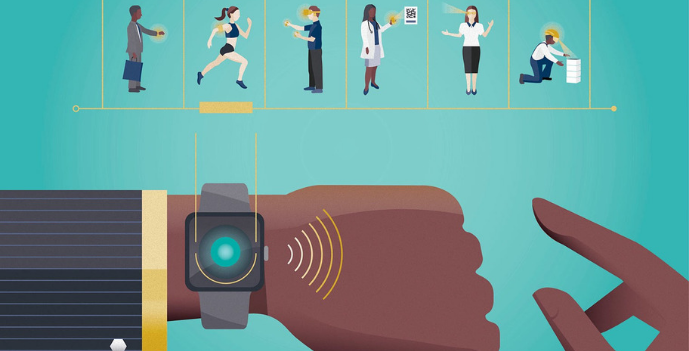
Wearable devices equipped with artificial intelligence and big data provide an important medical opportunity with a focus on accurate diagnosis, treatment, critical analysis, and anticipation. Wearable healthcare-related gadgets provide experts as well as patients with numerous advantages. The design of wearables in low-priced fitness took place in its developmental years.
The incorporation of "wearable technology" in medical applications has brought clinical services to the next level and allows patients to take advantage of the benefits.
Reputation faces tons of challenges in treating chronic disease, despite the fact that they invest a large number of dollars on it. Chronic conditions such as diabetes asthma, heart disease, etc. Regularly requires higher compliance and monitoring costs are also high.
The anticipated size of the international wearable device market in the healthcare sector is expected to grow to around US$ 5 billion globally. Smart Glasses Smart Camera Fitness Trackers Smart Clothing Sensors are some of the devices used.
Five Healthcare Trends Wearables- The same as smartwatches, continuous glucose monitoring devices, solid bandages, and heart bands, and wearable defibrillators- to give some examples- will later be vital applications for the healthcare sector.
The same as smartwatches, continuous glucose monitoring devices, solid bandages, and heart bands, and wearable defibrillators are some of the examples which will later be vital applications for the healthcare sector.
Wearable devices would be revolutionary, allowing both patients and clinicians to solve some of the conventional healthcare constraints. While these gadgets do not completely replace normal or current healthcare delivery or tracking methods, it is possible that wearables warn the patient or help medical experts track their patients remotely.
Medicinal care agencies, including patients, can also benefit from using wearables. The technology encourages them in the following ways to raise the level of health service. The sector does not remain in place, and there may be different developments in medicinal wearables.
Smartwatches and trackers, usually worn on the wrist, and Google glass wore with regular eyeglasses, get the most wearable designers attention. In addition, few mobile implants (e.g. cardiac) are becoming popular. Although the potential for advancement is enormous, devices for other body parts are slacking.
From now on, the trend is to develop more devices for various parts of the body, thereby increasing the reach of medical wearables. Using hearing aids, smart helmets, smart clothes, eyewear, shoes, skin patches, implantable sensors and many more, a person will almost certainly monitor their health and display their fitness since tipping to toe.
Wearable healthcare mobile app development keeps pace with current progress. A growing number of applications are made with the use of virtual reality, augmented computing, machine learning, and artificial intelligence and procedures.
Another type of software becomes more knowledgeable and replaces a lot of human work. For example, physicians get ready-made reports from Artificial Intelligence measurements, so they don't need to waste time and energy in studying or reading papers. It helps them to concentrate on patient treatment. Specialists can use VR goggles when working to see X-rays and never leave the room.
Some wearables have been structured in such a way that they can be worn as accessories and on different parts of the body. Others have turned out to be tiny to the extent that they are virtually invisible under your clothing or even on your skin.
This trend's main goal is to make devices increasingly portable and lightweight, and thus flexible and fair for each individual desire.
Today patients do not have enough time to get sick or spend on unnecessary services but should be treated exclusively. Wearables make this possible. Huge volumes of data collected by body sensors help to personalize the healthcare experience

Eventually, each client will be handled on the basis of personal data and symptoms rather than as suggested by the average-dependent medical models. The way specialists interact with their patients is shifting from uncertainty to personalization. Patient information will be even more accessible, allowing clinicians to find the right information.
Wearable technology advances have reclassified the smart medical services system provided these days. For both patients and professionals, the benefits of Wearables prompted the company to embrace it wholeheartedly. The demand for prominent wearable is not unexpected.
It increases the mobile applications ' interest in actually embracing such devices. Business analysts anticipate faster a broad acceptance of wearable technology in healthcare, as it will certainly bring about positive changes.
Wearables help prevent and track illnesses, offer input in real-time, remind patients to take medications, and help them stick to a planned plan. It is possible that in the near future we will most likely buy in drugstores biosensors and medical wearables.