
A focused modernization sprint that turns fragile, high-risk legacy platforms into a clear, phased roadmap your CIO, CFO, and regulators can all say yes to.
What’s inside the Sprint:

There’s that one system everyone depends on - and nobody wants to touch.

One small change can trigger a chain reaction: reports break, integrations fail, teams scramble. It feels less like a platform and more like a house of cards.
Meanwhile, the world around you isn’t slowing down. Donors, regulators, and partners are expecting faster reporting, tighter security, and better digital services. Your legacy core is quietly becoming your biggest operational and reputational risk.

You’re under pressure to ship new features — faster KYC flows, new payment rails, better dashboards. But every release feels dangerous because the underlying code is brittle, undocumented, and tightly coupled. Your engineers are firefighting instead of innovating, and investors are starting to ask hard questions.

Your teams in the field collect data in ODK/Kobo, spreadsheets, or scattered systems. The legacy MIS sits in the middle — unable to pull everything together. Reports to USAID/UN and other donors become monthly struggles, with manual cleanup and late nights just to meet deadlines. Everyone knows it’s not sustainable.
 IT wants to rewrite or replatform.
Leadership worries about the cost, disruption, and risk of a “black hole” modernization project.
So the decision gets delayed… again.
IT wants to rewrite or replatform.
Leadership worries about the cost, disruption, and risk of a “black hole” modernization project.
So the decision gets delayed… again.

Onboarding a new engineer into the legacy stack takes 3+ months.

Only one or two senior engineers “really” understand how it all hangs together.

You failed (or nearly failed) your last security or compliance audit.

Critical data is still trapped in on-prem servers with no clear backup or DR plan.

Integrating with new tools (mobile apps, analytics, AI, partner systems) feels painfully slow, or impossible.

Every budget cycle, someone says “we should fix this,” but no one has a clear number or plan.
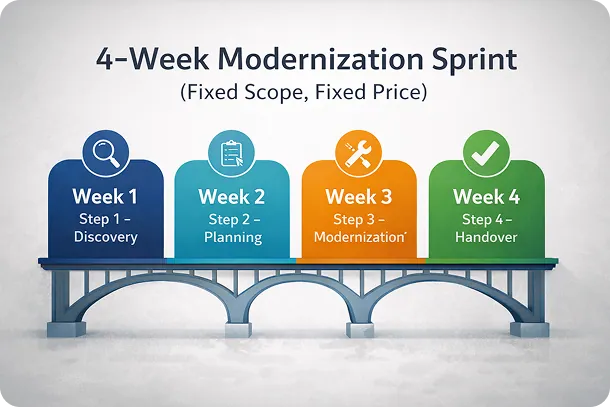
Modernization doesn't have to mean a massive, risky "rip and replace."
The Legacy System Modernization Sprint is a fixed-scope, fixed-price engagement designed to decouple the planning from the spending.
We don’t start by writing code. We start by diagnosing the patient.
In just 4 weeks, we audit your existing stack, identify the critical risks, and deliver a Phased Modernization Roadmap. You get a clear architectural blueprint and a precise budget for the rewrite, so you can secure board approval or donor funding without guessing.
No scope creep. We know exactly what we are auditing.
You pay for the Sprint, not an open-ended bill.
This sprint is built for Tier 1 and Tier 2 organizations operating in high-stakes, compliance-driven environments.
 Ideal Organizations
Struggling with fragmented M&E data, DHIS2 disconnects, and field reporting delays.
Series A/B companies needing to clear technical debt to pass due diligence or handle 10x scale.
System Integrators (SIs) needing a compliant modernization plan for public sector tenders.
 Ideal Roles
We specialize in high-stakes environments where compliance, security, and uptime are non-negotiable.
We make a complex, abstract problem extremely concrete. By the end of the Sprint, you’ll have more than a report, you’ll have artifacts your leadership can actually use to make decisions.

We analyze your legacy codebase and architecture to understand:
You’ll see a clear picture of where the danger zones really are and what it would take to stabilize or replace them.

We stress-test your system against the standards that matter for you, whether that’s GDPR, HIPAA, donor data requirements, or FinTech-grade security expectations.
You’ll get:

We design the “after” picture so you’re not modernizing into a mystery.
This includes:

Not every system needs a total rebuild. Sometimes stabilizing and refactoring is the smarter move.
We help you compare:
You get honest, scenario-based recommendations, not a default “let’s rebuild everything” answer.

This is where everything comes together.
We turn findings into a phased roadmap with budget ranges, so you can:

A decision-ready modernization plan you own,
whether
or not you choose us for the build.

You clearly separate planning decisions from build costs, replacing vague six-figure guesses with realistic budget ranges for each modernization option, so leadership and finance can compare scenarios side-by-side.

You move from promises to proof, equipping investors, donors, and boards with a documented roadmap, clear timelines, and evidence that systems will be auditable, reliable, and ready for scrutiny.

You identify and reduce risk before it turns into outages or breaches, prioritizing quick wins that protect critical workflows now while preparing safely for larger changes later.
You walk away knowing what to do, why it matters, and what it will cost—without committing to risky "big bang" rewrites or premature build decisions.
We focus on the parts of HealthTech where architecture, compliance, and real-world usage intersect.

A regional NGO relied on a 10+ year-old MIS stitched together with spreadsheets and manual uploads from multiple countries. Reporting to major donors was always late.
In a 4-week modernization sprint, we:

A fast-growing FinTech was seeing increased transaction volume, but their legacy payment core couldn’t keep up. Every new feature release felt like rolling the dice.
During the Sprint, we:
Stacks & Ecosystems We Understand
DHIS2, ODK/Kobo, custom MIS
AWS, Azure, and hybrid/on-prem realities
For FinTech-grade data handling and compliance
You’re not explaining your world from scratch, we already work in it.
We align on goals and gain secure access to your documentation and staging environments.
Our architects review the stack, interview your lead engineers, and map the data flows.
We design the target architecture and model the migration scenarios (Repair vs. Rebuild).
We present the final Modernization Roadmap and Budget to your leadership team for approval.
There are plenty of teams who can write code. Your challenge needs more than that.
We aren’t just coders. We are implementation partners for high-stakes, compliance-driven environments.

We work with NGOs and partners who must satisfy USAID, UN, and other institutional requirements, and prove it in audits and reports.

We design and modernize systems that handle payments, PII, and sensitive financial data where downtime or a breach is not an option.

We translate deep technical findings into language your CIO, CFO, and external stakeholders can align around.

From public-sector digital services to health data systems and donor platforms, we treat your legacy system like the critical infrastructure it is.

If you’re looking for a “cheap dev shop,” we’re not the right fit.
If you want a partner you can trust with your most important system, that’s where we come in.
We design the Sprint to minimize disruption to your day-to-day operations. Most of the heavy lifting is on our side. Typically, this includes:
No. You fully own the Roadmap and Architecture Blueprint. You can:
The Sprint is about clarity and options—not locking you into a long-term contract.
To keep the work deep and actionable, we recommend focusing on one primary system per Sprint. If multiple systems are involved, we help you prioritize them and design follow-on sprints or a portfolio-level roadmap.
That’s normal with legacy systems. We’re used to working with partial documentation, tribal knowledge, and single points of failure. A key outcome of the Sprint is turning that implicit knowledge into explicit, decision-ready architecture and documentation.
Yes. We routinely design systems aligned with HIPAA, GDPR, and major donor compliance frameworks (including USAID and UN standards). Compliance considerations are embedded into the Sprint, not treated as an afterthought.
If your team keeps saying “don’t touch that system,” that’s the signal. You don’t need another year of debate—you need a safe, structured way to move forward.
Book a Pilot Alignment SessionA short, no-pressure session to:
Shareable, executive-friendly overview you can circulate internally before making a decision.