
Explore the latest trends and find our updates on all you need to know about what is happening in the world of web and technology.

 18281
18281
 18 Sep
2019
18 Sep
2019
 4
min read
4
min read
Most people especially women love shopping and picking up items for their personal and home use. And when it comes to food products, they ensure that their pantry and family have every vital item. Now, the development of multi-vendor apps is occupying the center stage and the number of app development companies is rising.
What's more exciting is that you don't have to visit a traditional brick-and-mortar store or even a grocery store to choose an item if you have a busy timetable ahead. It is time to modify your company strategies strategically with the help of EPixelSoft in order to reach out to more prospective clients.
It offers a variety of food products in different customer places. It also enables clients to pick an appropriate delivery time based on their comfort.
As online grocery sales are on the rise, even supermarkets, have started offering various items through the app. When the customer is close to the store, they combine the functionalities of both customized and e-commerce food apps using push notifications and beacon technology.
There are some mobile apps that only offer grocery products. They enhance consumers ' shopping experience and offer services such as food list, food IQ, and delivery services.
The first important part is the registration page where the user would use his email ID and phone number to register his account. Once the account is registered, a private user profile must be created in which he must fill in some other personal information.
This is the most significant characteristic of the supermarket app that allows the client to search for a specific item and also helps him browse through the various item categories.
The grocery app should have the option Add to Cart where the client can add a product of his choice but later he intends to purchase.
Before making the payment, clients can inspect and handle the products so that they are sure that nothing has been added or left behind in the list.
Payment gateway integration becomes an important component of most on-demand applications, including grocery, making it easy for the client to pay using the various alternatives depending on his comfort.
Monitor the order status and know when it will be delivered.
Push Notification is another function that the multi-vendor grocery app needs to have. You can send the best offers and discounts notifications, appealing coupons, etc.
Customers will send their feedback on their use of the app experience to assist you further improve the services and schedule approaches.
The client support panel should not be forgotten to help clients select the correct item they are searching for.
This is a complete information center where the admin can handle all the customer orders received and create their services fast and on the go.
It helps the admin to conveniently handle the enormous inventory stock.
Once the order has been obtained and verified, the shop executives can assign tasks to the delivery of individuals to deliver the products at the said location.
Real-time analytics assist you to maintain your esteemed customers ' track records and also extract essential information when needed.
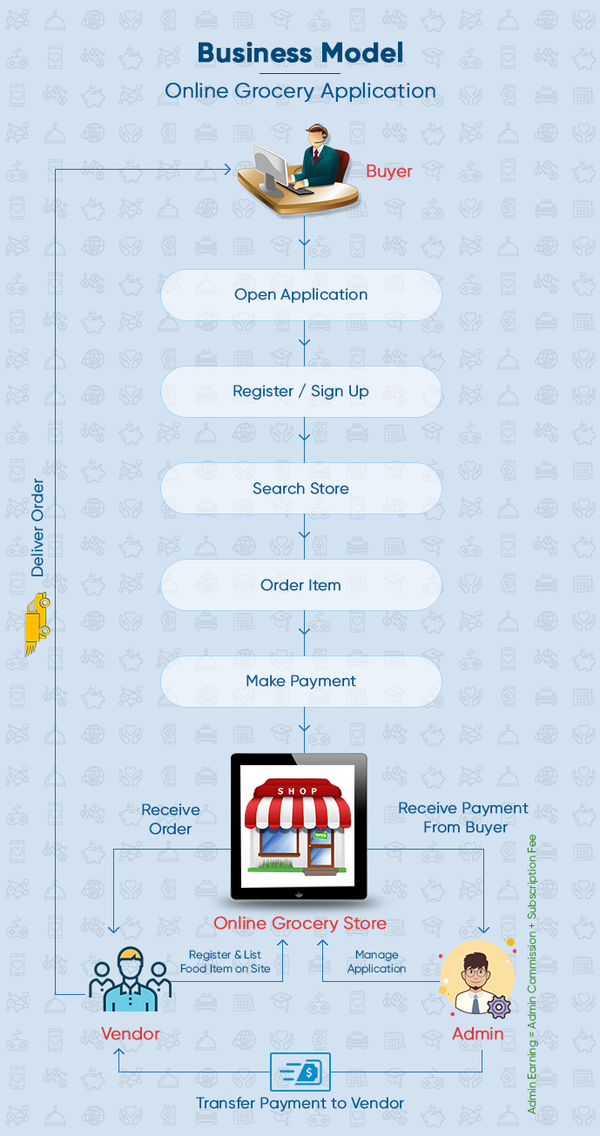
Help the supplier readily monitor the customer's location.
If the address can not be traced, the shipping individual or driver can contact the client directly via mobile or internet chat.
Together with the order number, it notifies the shop manager that the order may have been requested.
The significance of the product picture and its description becomes even more important when you are creating a grocery app.
When we speak about the price of grocery applications, several variables come into play including the platform, characteristics, app development team, pricing model and others, etc. However, on an estimate, the grocery app would cost you around $14k to 18k. Much, however, would rely on your choice of the App Development Company.
The future of internet grocery prospects are in thriving hands, and as time goes on, this on-demand app's client base would scale up. People are searching for more luxury and convenience, in the future, the market economy will also be boosted by these mobile application development services.

 9364
9364
03 Sep
2019
5
min read
Above all else, Uber is the taxi requesting application utilized by millions because of its exceptional service for individuals. There is no finish line you cross after spending a ton of time in development where you get to sit around and enjoy the fruits of your labor. The closest vehicle will pick you up in minutes.
There are constantly new features being added, or bugs being fixed, or updates being made to respond to a changing market or incoming competitors. Uber has 80 million clients and works in 77 nations. The administration is commonly 35 to half less expensive than conventional taxis, reacts quicker too. Also, that is the motivation behind why many need to pursue its way. Lyft, Hailo, Gett, and others have just succeeded.
Shouldn't something be said about the expense? Psyche, that nobody can assess the precise expense of building up a taxi application like Uber. Everything relies upon a tremendous assortment of things: application engineering and designer rates, highlights, nation and industry, and several others.
The features of the app are the major factor in determining the cost of developing a real-time location-based app. Some of the passengers and driver interface features will overlap, but each has its vital characteristics as well.
We should note immediately, that building up an application like Uber implies 2 separate applications with various usefulness:
For the individuals who book a taxi
For the individuals who get requests and ride you to your goal.
Rundown of highlights is the first enormous factor to the expense of taxi application development. A portion of the highlights of both traveler and driver interface will overlap, however, everyone has its basic ones as well.
The login email, credit cards, payment processing are some of the key features to look at when determining the cost of building this app. Other features include the booking interface that contains a screen for calling a taxi address, selecting a cab type, and setting a pick-up place.
Email as well as online networking login alternative, accounts, charge cards, installment preparing.
A screen to enter the location to call a taxi, select a taxi type (or explicit driver), set an area for pickup
To follow the driver's area, to make refreshes during or after a ride, and so forth. Tracking the location of the driver, making changes during or after a ride, are determinants of cost.
To check the evaluated expense of a ride from indicate A point B with certain taxi type even before requesting. The price calculator is also another feature used in checking the estimated price of a ride from point A to point B.
Cashless and in-application, paid naturally by means of charge card, clients get a receipt to telephone and email, or out and out money.
To maintain clients refreshed on control status, evaluated time of taxi entry, and different subtleties like vehicle model, tag, and so on.
Informing, evaluations and audits, booking history
Navigation such as using Google Maps or Google Places to communicate ideal instructions to a client and his destination; assessment of costs, reports, messaging, support.
With confirmation (charge number) and endorsement by a director, in addition to online status and calendar.
With alternatives to acknowledge or deny the approaching request, information on client area and goal of a ride noticeable quickly, in addition to booking history.
For request alarms, taxi booking information (area, installment, course, and so on.), for order updates and/or completion;
For example, utilizing Google Maps or Google Places to get ideal headings to a client and to his goal, could be voiced.
Cost estimation, reports, informing, support.
Having as a primary concern that Uber has effectively revealed its API to open and designers, and presented the Riders offshoot program, you can likewise fabricate claim custom-fitted Uber-like application. Server, mapping and installments are the three mammoth establishments to build up a taxi application. Most importantly, to process several client demands, driver courses and other information you need possess server. Programming dialects for backend- Node.js, Python, Java, PHP, Ruby on Rails. Another vital component to any Uber-clone application is GPS.OpenStreetMap API for the two iOS/Android can be utilized. Stage explicit devices in such a manner for Android could be Google Maps and Google Location Services API. For iOS gadgets- MapKit or CoreLocation structure.
As Uber underpins in-application installments through charge cards, Paypal, you may utilize the accompanying door connectors to build up application -tripe, Braintree, Paytm, PayPal portable SDK. Innovation stack for message pop-ups is truly direct: Google Firebase for Android and Apple Push for iOS telephones. For SMS send-outs Uber went freely with Twilio, however other cloud correspondence stages, as Plivo, Nexmo, Tropo, merit consideration.
Building the infrastructure - the backend is the basis with all the links between components. This is the first phase in search of how to create an Uber-like app. With all the characteristics we listed above, this would be the platform itself.
If you want to cut costs and build an easy taxi app like Uber, just one platform will be selected. This relies on the clients of your goal. Clearly, it would be preferable to cover both iOS and Android.
Backend and functionality would be the same for either Android or iOS, while platform-specific instruments and frameworks in use. Google Wallet or Apple Pay, for example, or multiple affiliate services from PayPal.
Hourly rates vary from place to place greatly, e.g. $20-50 Asia, $40-80 Europe, $100-150 in UK/USA. Assume, we calculate the cost to make an app like Uber at a median $50 rate...
Within the general timeline of app development, a passenger app (33%) and quality assurance (39%) would be the most time-consuming components. While building a driver app and admin/web application would take about 14% of the time each.
So, finally, how much does it cost to build an app like Uber? Or actually, how much can the cost range?
Summarizing all the factors, and making a mere approximation, the single-platform app like Uber would cost around $30.000 - $35.000 at a $50 hourly rate. While a basic app for both iOS app development and Android app development would cost around $65.000 but can go higher.
 7531
7531
19 Aug
2019
3
min read
Technology is evolving quickly, making preparing for the future difficult. But wearables and app integration technology are gaining momentum in fresh and interesting ways. This is one area where you can plan forward.
The emergence of wearables has succeeded in opening up a whole market segment that was fundamentally non-existent. The technology has succeeded in opening up a whole new world of possibilities and opportunities, and wearable technology has become much more sophisticated than handheld technology as the scenario stands today.
Wearable device development and innovation have been mainly consumer-centered from the start. But developers lately altered direction by developing business-related applications and expanding the market. It improves company productivity and speeds up workflow, according to professionals and top android app developers.
Due to app development and wearables such as exercise bands, trackers and smartwatches, our daily lives have altered completely. With user-friendly featured applications, mobile app technology integrated with wearables has made life more interactive and effective.
Top android app development companies such as EPixelSoft have developed apps that help you integrate with certain wearables to make things easier. Wearables also get very nice measurements for us. It monitors information in real-time to assist fitness enthusiasts to achieve their objectives.
It monitors real-time information to assist fitness lovers achieve their objectives as they provide us with a medium to safe, secure and assorted all of our health information. Furthermore, intelligent clothing has also produced its appearance, which at the same time enables individuals to look intelligent and health aware.
Developing mobile applications for wearables is proving to be a huge advantage for real-life operations. With the help of wearables, a whole new opportunity was also opened for healthcare professionals to create devices that could provide insight into the health of the wearer. As technology increases and improves over time, it is now simpler for experts to have data about their patients.
Navigation is another field that has excellent improvements with the advances in technology and the integration of app and wearables. Because of the wearable apps, consumers can now obtain instructions in their hands to their locations and this is a key area of wearable growth. Drivers ' lives change through wearables, taking advantage of GPS while driving.
A wearable device with a GPS as a guide will help riders achieve their final destination. Advanced data is also helpful in order to beat traffic and go on smoother routes, precise satellite direction is another advantage that comes with the use of GPS integrated wearables and to prevent the likelihood of road accidents.
The mobile app development for wearables will play a crucial part in the future as wearable technology continues to add value directly to customers. The evolution of wearables integrated with so much intelligence is increasing to take in a number of fields more creative gadgets. The technology is definitely promising, so the impacts of the same will also be greater.
8616
01 Aug
2019
4
min read
As you already understand, many apps are already flooding the location-based dating app industry. But still, as people want to come out of the swipe world and experience something new and unique, the demand for the new mobile dating apps is steadily increasing.
Today, individuals spend their highest time on dating applications. About 90 minutes a day. This implies that start-ups and businessmen in the dating app development sector can make good wealth by providing excellent and innovative services. But you need to think about the issue that your customers face while accessing present dating applications and provide an app-based solution that adds value to their life. As per a study dating apps has more than $2.5 billion market and 40% of US citizen use different dating apps.
The person must share the basic information so the prospect matches can know more about the user to get the interest. User profile on which the user places all the information such as name, location, address, sex, education, job, etc.
This is the main aim of the app to provide the best partner to the user as per the person's choice. After setting up match preferences, system algorithms to match the people accordingly, to offer possible matches, adjustable settings
Location-specific matches are another factor that a dating app should have. Location-based finding enables to search a match nearby the user. A user can set up a preference as per the convenient proximity.
Communication is the key for the users to chat with their match immediately after they like each other's profile. Some of the apps in the market allowing the girl to initiate the chat, so if the girl doesn't initiate the chat, there would not be any communication.
Since making a profile is free on most of the dating apps, people make fake accounts/profiles on the applications, to have a real person's profile a dating app can have a Facebook or LinkedIn signup feature to ensure the authenticity of the person.
Applications interact continuously with other systems such as back-end servers, cloud-based services, chat servers, GPS, etc.
Since the app stores, personal data such as name, number, social media profile and images and location, encryption is required wherever the data resides, whether in files, databases or other data stores.
Any service that requires customers to store their private information on the server must provide customers with full privacy control of their information. Controls of user privacy should be mitigated on the basis of the data they provide.
The owner of the app accepts third-party advertisements to show them in the app and gain from clicks, opinions or transactions
More spontaneous are single purchases or in-app purchases. People can pay for virtual gifts, tokens for discussion, more daily games, expanded search radius, etc.
For a certain period of time, consumers pay a premium for using the app. Ads: Apps create cash by selling ad room to third-party firms Premium plans: customers are charging extra characteristics to unlock.
As online dating becomes more common, more geolocation-based characteristics are now being used to discover your soulmate. They use your GPS information to match you in actual life with individuals you may be passing by.
The concept behind the dating app's matching algorithm is to link people with greater chances of swiping and starting a discussion. You can take particular measures to move to a greater league.
The approach is the only real location-based human interaction app to meet singles in real life and venues, bringing the human element back through your smartphone to introductions.
There's someone out there for everyone, no matter what you're in. That's why they have chosen these cool dating sites. They give a focused way of being together with like-minded individuals - regardless of the niche. Their content is timely and they thrive in their societies.
It is no longer so hard to build the ideal dating app. You can now use examples of already existing dating apps and find out a solution that these apps are not providing, build your own with new features that give an additional value to users.
Your app can be intended to give your member users a distinctive experience where they can meet just the type of individual they want. You can incorporate existing dating apps features to make it simpler for the users because they are already experienced with such user experience.
 16021
16021
17 Jun
2019
3
min read
It's difficult to say the next best thing about technology and what the Internet is going to be. Ideas are sparking and dissipating more quickly than we can. However, the Progressive Web App is one thing that certainly will remain here.
Progressive web apps (PWAs) are designed to provide mobile users with an unequaled experience. It is reliable and reacts to customers faster. Furthermore, mobile users are more than ever involved with an immersive experience. While many apps do this already, PWAs refer not to native applications, but to the mobile browsing experience. They combine the best of both worlds and are specifically created for mobile phones applications.
There are three main features that PWAs bring to there customers. They include;
-Trustworthiness/ reliability: PWAs should load immediately, whether online or offline.
- Speed: PWAs should load within less than three seconds and the content should be accessible instantly without delay or problem scrolling.
-Commitment: PWAs should have good content and empower users to add the app to their home screens. PWAs can also send customers to push notifications without downloading a particular application to obtain them.
Essentially, a progressive Internet app goes like an app and speaks like an app, but instead of on the phone, it lives in the Web browser. The user phones usually have less space and it is, therefore, ideal for the PWAs not to take much space.
The element of operating offline is one of the greatest distinctions between progressive web apps and traditional mobile sites. In the technology globe, this is a complete game-changer. With offline mode available in the progressive web apps for low reception areas, or those areas lacking service completely. Therefore enabling anyone to be able to reach a target audience when others simply cannot. Offline capacity, therefore, means increased user commitment, increased rates of conversion and even quicker speeds.
Many of the brands have already tested PWAs. Twitter is often praised for its PWA, particularly as more individuals monitor it to follow political news and activities. Someone with no Twitter account expects to see different tweets and trends. They can see the tweet in their mobile browsers instead of downloading the app and registering. This improves the traffic on Twitter rather than protecting all the material behind an indigenous firewall app.
Web-based industry specialists agree that the future of mobile use is progressive internet applications. Gartner claims that 50 percent of portable applications will be replaced by PWAs by 2020, meaning that we only see the tip of an iceberg as to what those applications look and do. Early evidence from Twitter and Pinterest encourages other teams to also invest in PWASs. Many companies will be free to reach customers and maintain them if they are to reduce the obstacle to using the PWA app.
With all these advantages and more, you can see why Web apps are the best thing to do. In your internet browsing experience, you get the same look, feel and quality of an app. Adjust yourself to the unwanted download room from applications you use only once or twice a month.
 2231
2231
30 May
2019
2
min read
Google launched Android Studio 3.4 and is ready to download on new Windows, Linux, and Mac versions. This is the latest IDE (integrated development environment) version that comes with a limited set of focused features.
It addresses the core resource management and app building workflows of the developer. You will be happy to know that more than 300 stability and bug enhancements are added to the new version. This is part of the Android Studio team's Project Marble effort.
Features
Memory management settings
If you are using a 64-bit operating system with at least 5 GB of RAM, you can now configure the maximum amount of RAM that your OS should allocate to Android Studio processes, such as the core IDE, Gradle daemon, and Kotlin daemon. To boost Android Studio performance, use these settings to provide the optimal amount of memory for each process.
Resource manager
Navigation and asset management used to be tedious and clunky on Android Studio. As the app became more complex, the difficulty increased. The new resource manager feature visualizes in the app's consolidated way to the colors, layouts and drawable elements.
Besides visualization, the panel supports the importation of bulk assets by dragging and dropping.
Layout editor properties
To enhance product refinement, Android Studio 3.4 comes with a refreshed Layout Editor Properties Panel. Warnings and errors come in a highlighted color and users can now enjoy binding resource control for each property.
The color picker has also been upgraded to refine the overall experience of the users. When you download the new version, you will find a single pane with collapsible sections with properties.
Import intentions
The common classes will be identified in these libraries by Android Studio 3.4 when you work with new libraries. To suggest the necessary library dependence and import the statement, it will use code intentions.
Users will be able to save time by this level of optimization, keeping themselves contextualized with the code. As you know, these libraries were modularized.
Incremental annotation processing
When using Android Gradle plugin 3.5.0-beta01 and higher, incremental Java compilation such as data binding is supported by even more annotation processors. This optimization leads to increased incremental performance in the building. See the table of incremental annotation processors for a complete list
Project structure dialog
Users will enjoy a new front end interface in Android Studio 3.4, through which they will be able to manage Gradle project files. This feature enables users to add module-level dependencies to their respective projects.
You can also use the new PSD displays to build variations to enhance the configuration of the files you are building.
 3021
3021
16 Feb
2019
min read
Gone are the days when mobile users often get frustrated with the page’s slow speed.
Mobile users can now have a fast-loading content experience like that delivered by Facebook Instant Articles and Apple News!
Yes, It has been made possible through Google’s Accelerated Mobile Pages.
Launched in October 2015, Accelerated Mobile Pages (AMP) project initiative aims at providing its users a better, faster, secure & effortless mobile internet.
Accelerated Mobile Pages is a stripped-down version of the mobile web which runs on HTML language. It is an open source initiative that enables publishers to load articles instantly for mobile readers.
How does Google AMP work?
There are three parts to Google AMP:
So how AMP can be beneficial in terms of marketing and search engine visibility?
AMP let publishers and marketers have control over numerous aspects of advertising. Tests have revealed that AMP pages can load 4 times faster. Some of its benefits in terms of marketing & SEO are stated below-
Accelerated Mobile Pages get a boost in search rankings:
The Accelerated Mobile Pages are not only being ranked above all other mobile results but also feature a small green lightning bolt logo under the search result making it faster than the others.
Faster rendering will give more page views and more ad views:
According to Kissmetrics, 40% of web users will abandon a page if it takes longer than three seconds to load.
So faster-loading mobile pages would seem to be in everyone’s interest – no-one is going to see an advert or read a brand message if they abandon a page before it loads.
Studies have revealed a potentially large increase of page views and ad views per unique session for publishers who switch to Accelerated Mobile Pages.
Support Tools and Functionalities :
Through AMPs, advertisers have the ability to traffic ads with ad servers of their choice, to support for multiple demand sources and formats (including native ads), and to have full control over ads placements, and viewability measurement.
Extending publisher Reach:
AMP-ready or AMP-compliant articles will load faster on mobile devices, thus extending publisher reach.
 2112
2112
You have an idea and you think your idea will become a success on the mobile platform. Typically more than one billion people using the iOS mobile phone in the world and the numbers are increasing every day. You need to get into the market with your idea before anyone else comes up with a similar idea and beat the game.
Initial execution process must be a deep market and competitor analysis, after that give your app a name and buy a domain name. Create a landing page for web presence.
If you have sufficient workspace then you can hire professionals such as a chief technology officer, a designer, iOS developer, and a tester or team size can be diversified as per the app you are building. But, this process needs lots of money for an in-house team set up. However, outsourcing your app development will save your cost and time. Hiring an outsourcing team will make certain to create your app with high standard designs, clean codes and this will ensure the application launch on time and within your budget.
When you start building the application, start promoting it from the same day so that at the time of launch your app will reach multiple mobile phone users that will get you a good number of downloads and installation. Here are a few key areas you may work to get more exposure-
Social presence: Social media is the biggest platform nowadays and you can use social media channels aggressively for your launch. Keep updating your social media accounts for your app. You can use social media management tools for automation.
Paid Campaigns: Paid campaigns become the fastest way to get involved with the audience nowadays, you can use facebook, twitter, Linkedin, Google AdWords, Bing ads for the pre-launch promotion of your application.
Video Campaigns: Create a promo video for your application and post it on video sharing websites. You also can post the video on your social media websites or web landing page.
Press Release: Post a pre-launch press release on some high DA/PA websites this will also help you to be visible on search engines.
Influencers: Most of the people are writing about the different market niche and most of them are influencers on the internet, you just need to find them. For example, if you are building an online food ordering application, you may see lots of people are writing a lot about food and related apps. You just need to find those people and make a list of them. Contact them and see if they will post about your product on their channels.