
Explore the latest trends and find our updates on all you need to know about what is happening in the world of web and technology.

 2276
2276
The whole world is anxiously grappling with the lockdowns and social distancing triggered by the COVID-19 epidemic. The virus outbreak is both an unprecedented challenge for the technology industry, and a unique opportunity too. Enthusiasts of artificial intelligence are pulling out everything to use this rapidly evolving technology as a tool to combat the pandemic.
Scientists, professionals and medical care experts worldwide are applying A.I. to understand better and contain the virus that causes COVID-19. This will allow them to treat infected patients better and potentially create vaccines that will avoid potential outbreaks.
For some time now, A.I. has played a tremendous role in enhancing the overall quality and performance of healthcare areas such as big data analytics and advanced computing. It has enabled the information to be shared and used in a completely new way. It has dramatically improved the awareness of diseases and illnesses by medical care practitioners. Given the severity of the global coronavirus epidemic, governments worldwide are using AI-based strategies to combat the pandemic.
Both medical researchers and virologists have pioneered work to understand the virus' structure. The epidemic has sparked unprecedented cooperation between researchers worldwide. It is primarily because of the COVID-19 outbreak size and severity. It is among the most contagious viruses ever known to the scientific community.
The virus structure represents a particular challenge for scientists. The virus belongs to an enveloped coronavirus family that comprises a single-started RNA structure. The fabric is covered up within a protein layer. It is similar to two-stranded viruses, such as HIV, Ebola, and Influenza. The tendency of the virus to mutate makes the production of a vaccine difficult for scientists.

That is where A.I. comes in. Tech companies around the globe are developing various AI-based techniques to assist the scientific community. Baidu Inc., for example, has made its Linearfold algorithm available to medical experts and researchers who are trying to control the pandemic. The Linearfold algorithm predicts the secondary RNA structure of the virus substantially more quickly.
The The AI-based algorithm offers useful insights for researchers on how the virus spreads from one species into another. Additionally, Baidu A.I. researchers have used the algorithm in predicting the secondary structure of the coronavirus. The phase of analysis was 120 times faster than the conventional way of analyzing the RNA.
Scientists believe that fast access to the virus's structure can shorten the development period for a vaccine dramatically with mRNA. Such vaccines may also have more excellent stability and effectiveness. Early vaccine development means a thousand lives are saved during an outbreak.
Together with machine learning, A.I. can effectively track the trends of the virus spread across communities, countries, and geographies. Better access to reliable distributed data can assist health care authorities in taking appropriate preventive and management steps. AI-based analytical methods can also be used to understand past patterns and trends in the spread. For healthcare practitioners, such observations will be incredibly useful. The authorities will establish successful containment strategies by integrating the AI-based data with the expertise of epidemiologists and other specialists.
Furthermore, A.I. and ML can be used to control infection risk. The most critical threats when it comes to coronavirus infection are habits and behaviors in humans. Such behavior patterns can be analyzed using A.I. and ML to manage risky behaviors and diffuse awareness.
Nearly every epidemiologist worldwide has emphasized the role of extensive screening and testing in containing the outbreak. South Korea was a premature adopter of this pattern. The country started widespread screening and managed to 'flatten the outbreak's curve without even imposing any lockdowns.
Healthcare authorities need to have active monitoring resources, especially in those places that are crowded like public places and hubs of transport. This would encourage healthcare professionals to isolate infected individuals and reduce COVID-19 spread. Tech companies and industries are developing AI-powered, infrared sensor systems that help humans in crowded places to monitor temperatures. China already uses these technologies in areas such as railway stations.
The novel coronavirus infection causes pneumonia as the most severe clinical disease. A chest C.T. scan is known for being the most accurate pneumonia diagnostic examination. With fewer medical care professionals in the middle of the outbreak, it has become challenging to conduct a large number of such diagnostic tests. The battle against COVID-19 will be more successful, with automated diagnostic tests and various medical care activities.

For example, LinkingMed, a company that analyzes medical data, has published an open-source A.I. model for the analysis of pneumonia C.T. images (source: MIT technology review). The AI-based technique can diagnose pneumonia rapidly and efficiently, and provide details such as the number, amount, and size of pneumonia lesions.
Also, automated medical care services such as telemedicine can be beneficial because of coronavirus infection for persons under quarantine or self-isolation. Such programs will improve the healthcare system and reduce the chance of contracting the virus for medical professionals.
The A.I. Avenue in the fight against COVID-19 is virtually limitless. A.I. and big data can be used together to explain the history of the spread of the virus across the globe. Methods of AI-powered data analysis will not only increase performance but would also help avoid future outbreaks.
We are observing the rapid developments in A.I. research and development. For AI-powered fast production of software and testing processes in place, we have the first-hand experience with A.I. technology. As a tech-driven company, we are hopeful that A.I. will drastically improve the fight against this invisible enemy.

 2867
2867
If you are using Microsoft Office, you have noticed several changes in the software suite application lately. Microsoft Word now offers better words or phrases; Outlook provides better support while writing an email; you get AI-based help when designing PowerPoint slides. Microsoft has ramped up the development of machine learning for its Office 365 applications. Both of these apps are machine learning based on Microsoft Azure.
Microsoft is continuously updating all those features and further expanding its machine learning capabilities. Also, the software recently renamed its most popular Office 365 suite to Microsoft 365. Microsoft is planning to give customers new apps and benefits. For instance, Microsoft 365 offers smart writing support in documents, emails, blogs, and many more. The Windows Editor-based AI and machine learning support have grown remarkably. Computer businesses are greatly benefiting from the partnership with Microsoft Office 365 and other similar initiatives.
Microsoft users have access to Microsoft Editor, which is an intelligent writing aid. This ML-based tool, among others, suggests better phrasing, grammatical errors, conciseness, and readability while typing. Such apps are more like writing aid tools such as Grammarly. Yet those are all built-in programs on Microsoft apps.
Azure machine-learning capabilities allow Microsoft to use a comparison of real-world numbers. The Bing browser has been using this for quite a while now. Combined with the advancement of machine learning, artificial intelligence implements such features as simple and more efficient. For instance, Word can recognize that the heading phrase is bold and recommend a style of heading.

The Outlook emailing software uses iOS machine learning to tell the user when to read an email. It can scan your message, as well. Also, Outlook applies machine learning and natural language processing (NLP) to recommend prompt answers to the emails you get. These replies may involve "looking ahead" or a schedule of meetings. Programming methods such as the development of Python enabled developers to incorporate these features efficiently into software applications.
For spreadsheets and any other significant document, Excel also uses NLP. It allows you to query your Excel data. PowerPoint Designer's machine learning capabilities can do great useful things for you. It leverages ML for text and slide structure analysis. The Presented Coach helps you to overcome issues such as slouching, speaking in a monotone, or even continually staring at the screen while presenting. With the use of machine learning techniques, the tool analyzes your voice and body posture.
Most of the machine learning skills that Microsoft applications offer are built using the Azure machine learning service. Features such as built-in Azure Cognitive Services APIs enable developers to create functionalities such as speech recognition. Many other features are focused on the creation of machine learning models, such as generating the Turing Neural Language. It is a model of profound language learning that has, among other things, the potential to learn to answer questions and full sentences.
The Azure Machine Learning platform enables both Microsoft and its partners to develop intelligent featured software solutions. It allows automation, processes data, and feeds the information into application training. These active machine learning and AI-based features facilitate collaboration with partners and Microsoft Office 365 to develop smart software solutions. We can expect more productivity-focused features in the future as Microsoft continues to upgrade its ML techniques.

Azure is a popular cloud computing platform with applications such as Service Infrastructure (IaaS), Service Application (PaaS), and Service Apps (SaaS). This is used for machine learning techniques and other applications, such as modeling, virtual computing, and networking.
Python is the most popular language of general-purpose programming used for the development of machine learning. R is used to analyze the data and to compute statistics. The machine learning language effectiveness depends on the region from which it is implemented.
Machine learning algorithms search for insight-generating natural patterns in the data. ML usage enables you to make better choices and predictions. They are used to create smart solutions every day, make important decisions in medical diagnosis and energy load forecasting.
Machine learning skills make your application software much more useful compared to the traditional solution. Microsoft enterprise software solutions are expertly designed to facilitate productivity for businesses and software developers. We use a wide array of Microsoft tools and technologies at our company to develop smart software applications.

Our customers are counting on us for feature-rich business solutions, which make business operations more efficient and profitable. Machine learning enables you to improve the productivity of businesses and allows you to understand your customers better. With increasing competition across different sectors, software solutions based on AI and ML will become the mainstream in the coming times.
 2169
2169
As the name indicates, a Robo advisor is a type of automated investment management service that needs little or no human interaction at first contact with the client. Usually, you open your robotic account and provide necessary information about your investments via an online questionnaire.
Robo consultants will then crunch the details you provide to create a diversified investment portfolio. When funds are invested, this software can automatically balance your portfolio- that is, change the investment required to attain your portfolio allocation.
The first thing in working with the Robo-advisor is to determine the investor client's correct allocation of assets and particular investment decisions. To start this process, the customer usually completes a risk tolerance questionnaire or similar form, which requires the customer to answer questions regarding their individual financial goals and risk tolerance.

The most commonly used investment method for Robo-consulting services is the Exchange-Trade Funds (ETF). In the Robo consultant method, certain forms of investment security, including inventories, shares, mutual funds, future securities, and real estate, may also be used. After selecting and allocating initial investments, the Robo advisor's software will be regularly adjusted over time.
The majority of Robo-consultants divide their portfolios also by risk. Thus, you are provided with a collection of investments that meet your criteria, based on your level of risk, ranging from aggressive to conservative.
Robo-Advisors are using algorithms like the Modern Portfolio Theory, which initially supported the traditional advisory group, which used automated investment strategies based on portfolio management algorithms.

Advanced Robo consultants use machine learning / AI techniques to develop their algorithms and import output continuously, but until now, such providers are rare. However, as technology progresses, the product may be further evolved and used more often.
Using it will help you avoid making mistakes. Often it is reported that one of the main reasons investors get poor results is because of their behavior. Investors make strategic decisions at the highs and lows of the economy based on good feelings. This technology does not allow that kind of mistake.
It is possible to automate the process thoroughly. When you open your account, the Robo consultant program is in charge of the investment process. You don't have to be worried about making adjustments in your product portfolio or spending more or less in a given market field. You don't even have the businesses to sign in and place.

Consulting firms usually require higher expenses and costs, much higher than those paid by consultants. You don't have to be worried about making a recommendation from a broker or another financial seller that isn't in your best interest.
Most Robo consultants have email, email, and chatbox only for communication. Others have reduced phone-service hours. There are a variety of Robo consultants not available during the weekends. This can be a problem because you are working throughout the week and investing on weekends.
If you are someone who wants a financial consultant, then most Robo consultants don't belong to you. The Robo has no office in which a customer goes directly to speak to the contractor. That sort of personal contact is confined to the traditional financial advisory models.
One of the issues that bother me about some Robo advisors is that they're positioning themselves as a financial planner substitute. The majority of Robo advisors are as good as the best financial planners in terms of portfolio design and are actually better than most purely due to their lower costs. Creating portfolios is a prod in itself.

And even more than a human-based financial planner. An excellent financial planner knows you personally and helps you create a plan that uses all the business tools that are available to achieve your specific personal objectives. Financial planners aren't independent advisers. The technologies may come, but they are, for the moment, merely a tool for applying and managing the portfolio.
This is true for any project, so it's not a blow to the Robo advisors directly. Nevertheless, some advertisements may make it feel like it offers an absolute return, which is not the case. Robo consultants are open to all of the threats that you may face. Our performances are fantastic at times. Often, you're going to lose money. That is just the way it is.
Robo advisors are relatively low-cost, but they still require more than the lowest all-in cost- one available fund.
Worse, on the other hand, it charges 0.24 percent for its basic management fee and pays for the underlying assets, which for most portfolios, will be about 0.11 percent. This is a total cost of about 0.36 percent per year. There's no significant difference between these two and Betterment is still much cheaper even with its management fee than most other investments.
If you want to evaluate low-cost investment management and want to obliterate yourself from portfolio management, then looking at a Robo advisor makes sense. Check out our Fusion Informatics Financial Robo Advisor Services, which will help you make trading more straightforward and more difficult.
 2639
2639
Artificial Intelligence is a paragliding term for technologies such as RPA and describes the ability of a computer to imitate human thinking. RPA is a rule-based, non-intelligence program that automates repetitive tasks.
Artificial Intelligence, the buzzword that has spread in the tech world, has given rise to hundreds of discussions about the developments that surround it, and how it is reaching the industries. All the hype around AI and its technologies -Robotic Process Automation, Machine Learning (ML), and Natural Learning Process (NLP)- has created a lot of confusion.
One of the many myths is that they are synonymous with Artificial Intelligence and Robotic Process Automation (RPA). Although both technologies stir great enthusiasm around the automation of business processes, they each perform this role differently. We decided to decommission once and for all the confusion surrounding Artificial Intelligence and RPA technology. Firstly, start thinking of RPA as
Robotic Process Automation (RPA) is a software designed to automate repeated manufacturing tasks to streamline business processes. The rule-based software evolved from screen scraping, workflow automation, and artificial intelligence to allow the software so that it can aggregate data, trigger responses, and initiate new actions.

Dubbed the RPA automated worker mimics human behavior to automate predictable daily workflows to increase productivity. The rules are designed, and the bots can extract and enter organized inputs from applications such as Excel into SAP. The software works just as a human would on the user interface, working efficiently with ERP and Customer Relationship Management systems.
Because of its ability to continually complete repetitive tasks that would otherwise be performed manually, the agile RPA program has gained enormous popularity and performance. Therefore freeing workers from repetitive activities and minimizing human error.
RPA's benefits prove it to be a reliable tool that achieves higher yield quality at a lower price tag and in less time than traditional methods. RPA tackles the process of IT support, workflow, and back-office work, all while boosting productivity at a lower cost than hiring a full-time worker.
RPA is useful for sectors such as insurance and banking with a high incidence of routine activities, but that's all it can do. It performs the tasks it intended to do efficiently and effectively without any real intelligence but the instructed rules, and nothing more.
As an individual, if you were to look up Artificial Intelligence, you would find an infinite quantity of knowledge (and fallacies) trying to explain its true meaning. The easiest way to define AI is to claim it is a paragliding term that describes a variety of technologies such as RPA and the ability of a computer to learn and mimic human thinking, such as judgment-based decisions, reasoning, and cognition.

So, let's break down that definition into two parts, AI technologies and the ability of a computer to imitate human mental capacity. AI opens a subset of technology such as ML and NLP that we can leverage to our advantage in doing more than just creating rule-based engines to automate repetitive tasks. AI now opens doors to such things as voice and facial recognition, voice assistants, and data analysis.
To render market and organizational recommendations, cognitive reasoning engines apply the collected data derived from observed patterns. What distinguishes AI from RPA is its ability to aggregate, manage, and understand unstructured data.
RPA and AI technologies are both great tools for streamlining business process automation, but they are a force to be relied on together. When AI is integrated with RPA, the automation process can be started much quicker, creating a continuum of automation.
A fully autonomous process would result in a more cognitive response, which would transmit it directly to the RPA system, which would then complete the task. This continuum of automation would result in production going even faster. This could be as simple as reducing waiting times on a customer inquiry issued during non-business hours when it comes to use-cases.
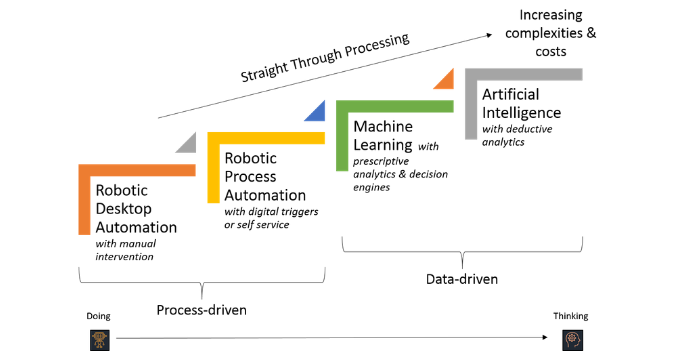
RPA and AI's future is burning ever brighter, as more companies continue to seek technologies that improve efficiency and cut costs. The technologies and techniques that continue to emerge from Artificial Intelligence will soon bring to the complete continuum of automation that businesses are desperately looking for as a front runner in today's fast-paced climate on a mission to exist.

We provide modular Robotic Process Automation (RPA) applications to use automatic rule-based engines to perform repetitive, manual processes. Using custom Blue Prism, UiPath, and Automation Anywhere integrations, these engines are designed to achieve a high volume and wide range of repetitive tasks with precision.
 2452
2452
In 2020, AI & machine learning will boost Fintech by improving the quality and flexibility of payment, lending, and insurance services while also helping to find new borrower pools.
The traditional tech stacks of Fintech were not designed to anticipate and act on real-time market indicators and data quickly; they are optimized for speed and scale of transactions.
What is needed is a new tech stack that can be flexible and adapted in real-time to changing market and customer needs. AI & machine learning proves to be very efficient in interpreting and recommending real-world actions.
The following are ten predictions of how AI is going to improve FinTech by 2020,
By using modern ML tools to assess which data sources provide the most predictive power for a model, lenders can get the most out of their data acquisition spending. Also, lenders will switch to ML to simplify their IT and risk operations by consolidating into fewer models that can do the job of what used to be multiple linear models for each customer segment.
For example, with one bank, Zest found that ML models can accurately target borrowers with the highest probability of making a certain minimum payment based on the value of their loan within 60 days of their due date. Within three months, to forecast this repayment propensity of borrowers, Zest built two models from traditional credit offices and the bank's proprietary collections metrics.
This creates an ideal situation among incumbent lenders, start-ups, data aggregators and CRAs for AI-related alliances and partnerships. To Harris, the stack layers are based on communication, intellect, and omnipresence.

Demonstrating the effectiveness of their talent management strategies. In 2020, Fintechs will increasingly adopt AI and ML to identify, recruit and hire the best development, engineering, marketing, sales, and senior management candidates. In 2020, Fintech CEOs and CHROs will start upgrading programs to improve AI fluency and mastery skills for themselves and their teams.
Zest forecasts borrowers will increase the use of ML as a way of growing into the no-file / thin-file segments, especially through Gen Zers with little to no credit history. Traditional tech stacks make finding and growing new borrower pools difficult.
Automated tools also shrink the time it takes to do fair lending testing by building less discriminatory models on the fly rather than the time-intensive approach of drop-one-variable-and-test.
Models built only in good times, when times go bad, can see their correlations break. Lenders who observe best practices when adopting AI and ML will ensure that their mod is stress-tested.

Credit unions will capitalize on ML by driving without added risk loan approvals and automating more of the loan approval process. By the end of 2020, 71 percent of credit unions plan to investigate, test, or fully implement AI / ML solutions, according to a Fannie Mae mortgage lender survey-up from just 40% in 2018. In order to improve investigation resolution, AI and ML will also be adopted across credit unions.
 2267
2267
 29 Oct
2019
29 Oct
2019
 5
min read
5
min read
The advancement of artificial intelligence and machine learning is rapidly taking over the most resources in the modern-day world. Automated systems that can deliver precision-based instructions with effectiveness are built to take over some of the most popular activities. One of the fields, emerging is engineering. This has had an impact on supply chain and Logistics.
Artificial Intelligence is a computer's ability to make smart decisions that are equivalent to preforms of human intelligence based on the data gathered. Thus artificial intelligence applied devices can read, analyze, and react on the basis of the data collected. With the aid of machine learning patterns, it can learn on its own and produce an excellent result.
Most of the leading companies embrace Artificial Intelligence and machine learning to turn core strategies into real-time decisions related to issues such as price, stock, and carriers, and vehicle and truck transportation, etc. While these innovative technologies produce data, data were normally generated by the transportation industry to provide useful insights.

The new logistics and transportation operational methods have been developed in recent years. Artificial Intelligence technologies can grow businesses by providing useful input and allowing businesses to be more efficient. By knowing what to expect, they can reduce the total number of vehicles necessary for transportation and direct them to the locations where the demand is required.
In order to avoid risks, AI can collect data from different resources and helps develop solutions. This allows the logistics and supply chain to make changes based on the data provided and used to optimize business profit.
Efficient inventory control predominates in customer satisfaction and competes for advantage. Artificial Intelligence may be pleased with the access data, such as real-time stock and inventory rates, as well as the load size of vehicles for distribution efficiency, in line with becoming a reasonable value and secure both.
Artificial intelligence can also track and predict manufacturer record levels and product availability in advance, so customers are aware of the exact amount and planned for future performance at the time of delivery.
The logistics field is dynamic and multi-structured, involving architecture, flexibility and adaptability skills. Furthermore, the automation of logistical work methods with the correct system can effectively improve the allocation of time and money while assessing a company's logistics, reducing costs and risks, and improving productivity.
The technique of conducting forecasts using data analytics based on generated information is predictive analysis. For a specific analysis, this approach creates a predictive pattern. In addition to analyzing data, statistics and techniques of machine learning are also used in this pattern to determine future outcomes
Even before the customer places an order, the needs analysis provides the logistics team with a view to increasing productivity and performance. Lack of tolerance for late deliveries by consumers is one of today's leading portions of evolving logistics. Customers need to arrive at the exact time.
Personal assistants enable the customer to obtain basic data by responding to their requests. As AI assistants become more complex, they can manage many customer-focused enterprises at all levels of the supply chain, including receipts for approaches, sales, executive duties, consumer service and more.
Eventually, the software will incorporate a cost-effective method to integrate with consumers while providing strong and consistent service to customers.
Artificial Intelligence Supplier Relationship Control can develop supplier preference and improve supplier relationship control effectiveness. Supplier-related opportunities are a major concern for experts in logistics.
AI can analyze supplier-related data such as time in full control output, inspections, reviews, and fair ratings, and generate data to be used for final supplier-related decisions. A business can make accurate supplier decisions and strengthen its customer service as a result.
AI has the ability to collect information from situations and offers knowledge to assess the key factors for cost reduction and reactivity. Applying AI and machine learning on a number of levels is a critical advantage for logistics.
The application of AI technology in logistics involves Intelligent Robotic Distributing secure, high-speed sorting of unregulated shipments, documents, and palletized freight with the guidance of robots powered by Artificial Intelligence to reduce human intervention and failure rates.
Using smart value resources to build robust processes in today's marketing world is a key phenomenon. Machine learning in supply chain management deals with stock, demand, and supply forecasting.
The software would turn the supply chain inference operation and optimization to develop. This kind of skill can automate the distribution of resources by taking into account demand and value, and would not want human evaluation, but criteria of progress setting efficiency.
By giving them personalization, it has the ability to change relationships between logistics suppliers and customers. Using the voice assistant, it can monitor shipments and collect delivery information.
The customer can ask the question about the details of their shipment and the time of arrival, etc., as they acted as the company's customer support tool. AI is a well-formed model and machine learning recognition system. In some of the high-level supply chain and logistics solutions, the technology already plays a vital role, developing efficiency, capacity and automating various responsibilities.
Artificial Intelligence continues the road of digitalization growth and becomes a large and important part of everyday business. AI gaining from expertise in sectors such as logistics is a beneficial tool for recognizing significant issues.
Artificial Intelligence has an important role to play in driving the journey toward a logistics perspective that is analytical, positive and tailored. This is one of the country's leading AI development companies offering the best AI solutions for different industries, including logistics.
 1908
1908
17 Oct
2019
5
min read
Nowadays, chatbots benefit businesses by getting more business customers. Implementing the development of chatbot as the way of communicating with the customer is becoming more important for responsiveness in business and this has remained to be a great competitor in the world of business technology.
Many consumers prefer to engage in business with products that are more sensitive. The chatbot development companies are developing their innovation to assist their customers with business in their businesses. If your company is in the online marketplace, mobile app chatbots can help remain accessible to your customers 24/ 7.
A chatbot is a software that is technologically designed to communicate automatically with humans through the website or any mobile applications through an internet connection. It is one of the useful technology that allows the company to connect with customers by reacting to certain quires and replacing the manual response process.
The chatbots use Artificial Intelligence, Machine Learning, Predictive Analytics, and Natural Language Processing to learn from past conversions and act smartly over time. The innovation of advanced technology such as NLP Chatbots allows machines to converse with people more intelligently; it easily evaluates the meaning and user intent.
The consumer wants more data and product details from the companies and businesses to focus on promoting their customers ' customized experiences. Knowledge Chatbots helps to meet the usability functionality to provide better customer support and maintenance.

Developing chatbots intelligence helps to learn from conversations on its own and can manage any and every customer-friendly condition. In order to retain customers involved, chatbots can manage visible content such as videos and models. In greater action, character-driven exposure to consumers is improving. However, a combination of AI and NLP is developed this time to form chatbot.
This technology enables organizations to have complete control and access to chatbots inspection. Implementing AI and Natural Language Processing and Machine Learning can allow apps to fit into the existing business to better communicate with customers.
Through these tools, a company can take advantage of additional chatbots, such as the combination of APIs and traditional messaging apps such as Skype, Facebook, and Whatsapp.
Chatbots are a strong system built by AI and NLP for their business use. More and more companies are accepting chatbots to help and support their customers with regard to products and services, where chatbots are self-learning systems, the ability to communicate naturally with people.

Both companies are watched by consumers and linked for company reliability and responsiveness. With AI NLP chatbots, it is possible to grow advanced interaction with customers by creating robust and reliable business chatbot applications.
Chatbot development companies are investing their skills and time to build chatbots applications to conduct interaction actions with users in the form of text and voice, as advanced technology has now arrived, chatbots are intelligently able to more accurately understand the user context and speak languages. The chatbot software can monitor the purpose of the user and can be incorporated.
The device has the ability to interact more spontaneously with individuals, providing the user with a personalized experience to connect more. Safe Features The software also stands for its safety standards in the chatbot advancements and provides the organization with security technologies and functions.
Even if misphrased, smart chatbot can recognize the user's expectation. It has the intelligence to learn better conversions from the conversion of the future.
By implementing AI chatbots and ready to respond to customer queries and questions in real-time interaction, the business will be available for 24/7.
The Implementing Machine Learning Chatbot is a crucial process that requires perfect training and precise algorithms to achieve a consistent pattern and make customer interactions more effective. If data property is not suitable or not used with the correct method of machine learning, businesses will find inaccurate responses
To prevent the need for business people to hire the best chatbot development companies to train the software with high-quality data in proper machine learning training to avoid this type of problem. Fusion Informatics is one of the leading development companies in machine learning to provide the best services to businesses seeking chatbots to explore.
Fusion Informatics is one of the leading Chatbot development companies to help our customers embrace chatbots, providing services for various stages of deployment in your business. We provide comprehensive chatbot solutions that enable the coloring of your business.

We understand each stage of business conducts and its items and provide our products to help your business assist your customers in an automated manner. In order to understand the customer viewpoint, we design and deploy the chatbot for your company and respond accordingly. We create high-quality, personalized chatbots with information, interaction capabilities, and acknowledgment.
NLP is an advanced method by which devices can determine the meaning of user context data. In doing so, it seeks to know the intention of the data, not just to learn about the intention itself. In the system, the customer automatically adds NLP chatbots to the system.
 Achieve a more natural approach and customers prefer to ask more questions as they think as they interact with people. By replying to the default response, you may try to change it. The role of NLP in chatbot implementations helps the consumer feel natural in real-time and allows customers to ask questions and systems to understand, recognize the relevant data in-process interactions to simplify and motivate.
2260
16 Oct
2019
6
min read
Artificial intelligence is a seaming transition that captures almost every modern field in the technological modern world. AI's role becomes inevitable more especially in simplifying the medical domain's strenuous risk. AI is actually the technical wizard's need to seek immaculate results in few hours.
Overwhelming data makes it a perfect choice for using AI over different orders, from discovering and pathology to sedating discovery and researching transmission of disease. Meanwhile, the effect of medicinal data poses fundamental questions about protection and safety in this industry.
Approximately 90 percent of all health information comes from technology in the field of imaging, but by far the majority goes unanalyzed.
Using AI can reshape restorative diagnostics over these two parameters. As suggested by experts, a concrete aim is to train AIs for various diseases with the goal of introducing future X-beam determinations.
The initial phase of the prohibition protocol is to interpret the limitations of current emergency clinic traditions, why we need AI in intense consideration, and finally how the direction of basic therapeutic leadership will shift with the reconciliation of AI-based research.
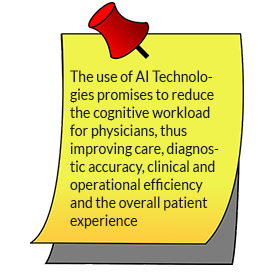
Next step is to create a plan to change the focus of clinical learning to allow doctors to retain AI oversight. The organized transition to AI must be managed by physicians, medical practitioners & experts in the field of secure emergency clinic communication Consideration of the fact that there is a vital risk during the time frame of development & great deal of hazard is inconspicuous, extraordinary to the emergency clinical condition & outside the expertise of the designers of AI.
The world's experts believe that embracing artificial intelligence in the medical field promotes rapid development. AI-enabled restorative tools are developed and assume control over parts of human resources, the therapeutic risk area should be addressed. Organizational foundations and studies announce that AI systems can beat specialists to diagnose coronary disease, identify skin disease, and conduct medical procedures. For man-made intelligence, intensive attention is needed because AI recognizes complex social time schedules within datasets and this
The artificial man-made technology will take care of patients and see whether a person wants to be treated by the doctor. The biggest ever-restorative bureaucratic approval was handed over to the IDX-DR retinal scanner by the US government to a self-ruling AI device.
The designers received special insurance for medical negligence to address the main problems. An alliance would investigate the vulnerability of each AI item and encourage the manufacturer to popularize it as a by-product of charging the controller the correct risk fee.
An increasingly contentious suggestion was the idea that a self-governing AI system could be legally treated as an entity, and thus could be accused of an off-base choice itself. "Electronic character" would suggest the possibility of keeping AI software at risk of errors.
This could be a response to situations where a properly coded AI device prepared on an appropriate information index achieves a restoratively careless outcome. It would be shielded from its mix-ups on the off chance that protection was needed for electronic people, general society, and the therapeutic professional depending on an AI device.
The European Parliament late endorsed this agreement and, despite the fact that it may be futile and inopportune at this stage as AI systems are increasingly autonomous, it may be an interesting solution to the issue of risk is resolved.
Maintaining consistency in the paves of medicine dominates the ability to ensure a particular person's genetics, behavior, and body condition. It offers a range of knowledge to physicians to pursue appropriate treatment for various diseases.
Performance can only be accomplished if the intellect retains the physician's nature and improves skills at a considerable rate. We must emphasize the importance of integrating these measurements with doctor results.
 In the major challenge of the International Symposium on Biomedical Imaging, Methods for the detection of malignant metastatic bosom development in whole sentinel lymph hub biopsies slide pictures. The measurement of the champ had an achievement rate of 92.5 percent. When a pathologist analyzed similar pictures autonomously, the level of achievement was 96.6%.
A notable use of AI in social insurance involves selection, storage, standardization, and the trace of data. The Artificial intelligence research part of the member, Google, propelled its Deep Mind Health venture, which is utilized to mine the information of restorative records so as to enable better and quicker wellbeing administrations. At that point, the program recognizes the necessary treatment plans for a patient by combining characteristics from the patient's record with clinical mastery, external research, and information.
Virtual patients are a unique design pattern of an intuitive system that simulates real-life medical scenarios; learners mimic the roles of health care providers in learning information, evaluating, and making clinical and restorative decisions.
The goal of VPs is to link digital worlds in 2D and 3D and to engage in intense and private consumer interactions. Artificially designed VPs interact verbally and nonverbally, and the most advanced VPs achieve verisimilitude through engaging in rich conversations, perceiving nonverbal prompts, and considering social and passionate variables.
Having VPs provides a few focal points in addition to traditional medical skill presentation approaches. For example, web-based learning materials, VPs, are useful everywhere if there is a web-based PC. Virtual patients are homogeneous to real patients, eliminating ambiguity in disease formulation.
There are more unresolved questions now than we can handle and hopefully, this will clear up as AI turns into practice with open discourses around the world. However, computer-based intelligence has real social security constraints.
Gauging and expectations depend on priority due to AI but estimate that fail to meet expectations in new cases of drug reactions or therapy interference where there is no earlier expansion guide. AI may not, therefore, substitute tacit data that can not be easily identified.