
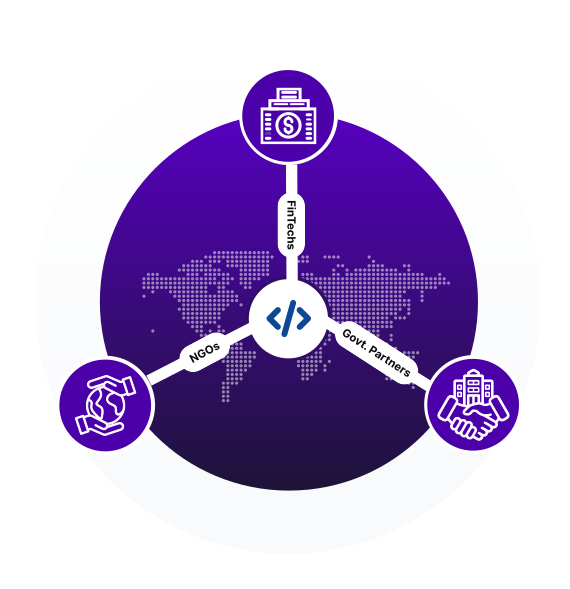



Serving teams across Africa, MENA, and global markets

Global Digital Transformation Engineering for Compliance-Driven Sectors.

De-risk your next digital initiative. We provide compliance-validated engineering and strategic roadmaps for NGOs, FinTechs, and Government Partners.

Trusted by:

KFC
Indigo
Allianz
Wego
Fortis
Clients

1,200+

clients worldwide

Projects

100+

projects shipped

Industries

30+

industries served

Who We Build For

We work with teams who need reliable, long-term technology partners — not just one-off vendors. From NGOs and public sector programs to fast-growing SaaS products and enterprises, we design systems that are practical, scalable, and built for real-world constraints.

NGOs & INGOs

NGOs & INGOs NGOs & INGOs

Offline-first tools for field data collection, M&E dashboards, and donor-ready reporting across Africa and emerging markets.

FinTech & Digital Lending

SaaS & Product Companies FinTech & Digital Lending

Loan origination, KYC, collections, and digital customer journeys — built to be secure, compliant, and ready to scale.

Public Sector & Smart Cities

SaaS & Product Companies Public Sector & Smart Cities

Citizen portals, service delivery systems, and digital field tools that make public services faster, more transparent, and easier to access.

SaaS & Product Companies

SaaS & Product Companies SaaS & Product Companies

End-to-end product development — from discovery and MVP to multi-tenant SaaS platforms and continuous feature delivery.

View Solutions by Industry Arrow

Real Projects, Measurable Impact

Every project is tied to clear business or impact outcomes — increasing loan approvals, improving field data quality, or reducing manual admin. Here are a few examples of how we’ve helped our partners scale with confidence.

Case Study

WanderGo — FinTech Lending Platform

We partnered with a growing fintech to launch a secure digital lending platform that supports rapid onboarding and smarter approvals.

FinTech Africa

What we delivered:

  • Industry

    Custom loan application flows with instant eligibility checks

  • Industry

    Real-time funding calculator and lender quote engine

  • Industry

    Integrated repayment system with automated schedules and reminders

  • Industry

    Intuitive dashboards for borrowers, agents, and admins

  • Industry

    Automated underwriting and digital contract signing

Outcome highlight:

Reduced manual processing by 50% and accelerated loan approvals for
retail customers.

View Full Case Study Arrow
2
3
4
5

Our Engineering Core

Building the future with scalable, secure, and intelligent technology
for compliance-driven organizations.

Custom Software Development

Web & Mobile Platforms

We engineer responsive web platforms and offline-first mobile apps designed for the field. From NGO program dashboards and citizen portals to high-traffic FinTech & SaaS products, we deliver fast, reliable experiences across devices, geographies, and bandwidth conditions.

ReactJS React Native Flutter Angular Vue Vue
Mobile App Development

Cloud Infrastructure & DevOps

Deploy faster and scale with confidence. We design resilient cloud architectures and automated CI/CD pipelines so your systems can handle millions of users, frequent releases, and peak campaign traffic—without downtime or surprise failures.

AWS Azure GCP Docker Kubernetes Terraform GitHub Actions
Web Development

Security, Compliance & Governance

Protect your data and your reputation. We embed security and compliance into every layer—access control, encryption, audit trails, and monitoring, so your platforms are ready for GDPR, HIPAA, PCI-DSS, donor audits, and financial regulators.

OAuth 2.0 / OpenID Connect Zero-Trust Architecture Penetration Testing AES-256 Encryption SIEM / Logging
Mobility Solutions

Data Engineering, Analytics & AI

Turn raw data into decision power. We build data pipelines, warehouses, and machine learning solutions that automate reporting, power M&E dashboards, score risk, forecast demand, and surface insights your teams can act on in real time.

Python SQL DBT TensorFlow / PyTorch NLP Power BI / Looker / Tableau Big Data Platforms

How We Work With You

We don’t jump straight into code. We start with clarity — aligning stakeholders, defining outcomes, and validating the approach before major investment.

iscover & Align
01

Discover & Align

We map your goals, users, constraints, and success metrics – aligning internal teams, donors, or board stakeholders on a shared roadmap.

Design the Roadmap or MVP
02

Design the Roadmap or MVP

Through workshops and rapid prototyping, we define user journeys, architecture, and a realistic phased plan (pilot, rollout, scale).

Launch, Train & Support
04

Launch, Train & Support

We handle deployment, documentation, handover, and training — then stay involved for optimizations, new phases, and continuous improvement.

Build, Test & Validate
03

Build, Test & Validate

Our engineers and designers work in agile sprints, with regular demos, testing, and feedback loops to ensure we’re building the right thing.

Start Small, Move Fast — With Fixed-Price Accelerators

Reduce risk and build internal confidence before committing to a large build.

Digital Transformation Accelerator
4–6 WEEKS

Digital Transformation Accelerator

A structured program to audit your current systems, identify quick wins, and map a realistic multi-phase roadmap.

Product Discovery & MVP Workshop INTENSIVE ENGAGEMENT

Product Discovery & MVP Workshop

For SaaS founders and innovation leaders — we help you validate the concept, define user journeys, and shape an MVP that investors and stakeholders can back.

Legacy Modernization Sprint FOCUSED SPRINT

Legacy Modernization Sprint

A focused engagement to assess, prioritize, and modernize parts of your legacy systems without disrupting day-to-day operations.

Explore All Accelerators Arrow

Built on Modern, Proven Technology

We’re stack-agnostic and choose tools based on your security, compliance, scalability, and internal team skills — not just what’s trendy.

  • Angular

    Angular

  • ReactJS

    ReactJS

  • NextJs

    NextJs

  • VueJs

    VueJs

  • TypeScript

    TypeScript

  • HTML

    HTML

  • CSS

    CSS

  • JS

    JS

  • Bootstrap

    Bootstrap

  • Python

    Python

  • PHP

    PHP

  • Node

    Node

  • Java

    Java

  • Django

    Django

  • Laravel

    Laravel

  • GraphQL

    GraphQL

  • Flask

    Flask

  • Gemini

    Gemini

  • ChatGPT

    ChatGPT

  • Copilot

    Copilot

  • KaneAI

    KaneAI

  • Claude

    Claude

  • GitHub Copilot

    GitHub Copilot

  • Deepseek

    Deepseek

  • Cursor

    Cursor

  • Crew AI

    Crew AI

  • Llama

    Llama

  • MySql

    MySql

  • PostgreSql

    PostgreSql

  • MongoDB

    MongoDB

  • DynamoDB

    DynamoDB

  • Redis

    Redis

  • Algolia

    Algolia

  • Cassandra

    Cassandra

  • Selenium

    Selenium

  • Cypress

    Cypress

  • Appium

    Appium

  • Postman

    Postman

  • Cucumber

    Cucumber

  • Lambdatest

    Lambdatest

  • Webdriver

    Webdriver

  • Adobe PhotoShop

    Adobe PhotoShop

  • Figma

    Figma

  • Adobe XD

    Adobe XD

  • Kotlin

    Kotlin

  • React Native

    React Native

  • Swift

    Swift

  • Flutter

    Flutter

  • JS5

    JS5

  • Dart

    Dart

  • AWS

    AWS

  • DigitalOcean

    DigitalOcean

  • GCP

    GCP

  • Azure

    Azure

  • Jenkins

    Jenkins

  • CI/CD

    CI/CD

  • Kubernetes

    Kubernetes

  • Docker

    Docker

  • Terraform

    Terraform

  • Grafana

    Grafana

  • Cloudflare

    Cloudflare

  • ELK

    ELK

  • Nginx

    Nginx

  • Ansible

    Ansible

  • Amazon Redshift

    Amazon Redshift

  • Kafka

    Kafka

  • Data Bricks

    Data Bricks

  • Apache Airflow

    Apache Airflow

  • Apache Spark

    Apache Spark

  • Snowflake

    Snowflake

  • AWS Glue

    AWS Glue

  • Salesforce

    Salesforce

  • Microsoft Power Platform

    Microsoft Power Platform

Industries We Understand Deeply

We bring hands-on experience from projects across Africa, the Middle East, and global markets — especially in impact-driven and regulated sectors.

Finance & Banking

NGOs & International Development

Offline-first data collection, M&E dashboards, and donor-ready reporting systems for multi-country programs.

Healthcare

FinTech & Digital Lending

Secure, compliant platforms for loan origination, KYC, collections, and digital wallets.

Public Sector & Smart Cities

Public Sector & Smart Cities

Citizen portals, service delivery systems, and digital tools that improve transparency and efficiency.

SaaS

Healthcare & HealthTech

Patient portals, telehealth, and operational platforms with strong privacy and security.

Education & EdTech

Education & EdTech

Learning platforms, content delivery systems, and analytics for teachers, learners, and institutions.

SaaS & Product Companies

SaaS & Product Companies

B2B and B2C SaaS products from MVP to global scale.

Plan Your Next Phase of Digital Growth

Whether you’re digitizing field operations, modernizing a legacy platform, or launching a new SaaS product — we’ll help you shape a clear, realistic roadmap before you commit to a full build.

No obligation, no hard selling - 30 minutes to understand your context and options.

What Our Clients Say

Our clients value reliability, clear communication, and long-term partnership. Here’s what some of them say about working with EpixelSoft.

NGO
Client testimonial quote

The custom data-collection platform ePixelSoft built cut NGO reporting time by 70% and made donor audits effortless across three countries.

Emma Clarke

Chief Innovation Officer

FinTech

Their cloud-native billing system reduced operational costs by 40% and maintained uptime during peak lending cycles — a real win for our FinTech product.

Mark Davies

Director of Digital Operations

Public Sector

Our ERP now delivers real-time program KPIs — enabling faster, evidence-based decisions across regional offices.

Lucía Martínez

Global IT Director

NGO

Supply-chain automation removed repetitive manual checks and cut lead times by 25% for our humanitarian shipments.

Hiroshi Tanaka

Director of Operations Excellence

SaaS

Their CRM gave our SaaS sales team pipeline clarity and increased trial-to-paid conversion by 18%.

Sophia Johnson

Chief Executive Officer

Govt

The unified operations dashboard gave our public-sector team total visibility — cutting incident response time by 50%.

Michael Thompson

Chief Information Officer

A Long-Term Technology Partner for Impact & Growth

We’re a team of engineers, designers, and product thinkers who care about the real-world impact of the systems we build.

Headquartered in India and working closely with teams across Africa, the Middle East, and global markets, we specialize in building digital platforms for NGOs, fintechs, public sector programs, and fast-growing product companies.

We are a Recognized Agency

Recognized Agency
Team collaboration

“We are architects of impact, not just writers of code.”

– Engineering Leadership

Our Core Values

Precise Fullfilment

Precise Fullfilment

We build what you actually need, not what just looks good in a slide deck.

Precise Fullfilment

Precise Fullfilment

Senior talent, clear communication, and dependable delivery.

Attention to Detail

Attention to Detail

From data models to UX micro-interactions, details matter.

Timely Delivery

Timely Delivery

We respect your timelines, governance, and funding cycles.

Let’s Build Together

Latest Blog Posts

Stay updated with the latest trends, tips, and thought leadership shaping the digital world.

5 Tips for Creating a More Usable eCommerce Website

E-commerce is really a very competitive area because your rival is a maximum of a click ahead. If a client doesn’t like your website, he simply seeks another e-commerce site to purchase products from. If you wish to gain more clients and attract interest, you want to be certain that your website is really as usable and as customer-friendly as you possibly can.

It doesn’t matter in case your prices are really low or you possess the best products in the market because if clients get confused navigating your site, reaching the preset target will probably be difficult.

Usability means you need to make the purchasing process as quick so that it would be as easy as feasible. These tips enable you to create a much more usable e-commerce website that may create higher conversions.

Avoid lengthy sign-up forms that may take a few pages approximately before visitors may successfully register for your site. As a good e-commerce site, you don’t actually have to know their address, telephone number, what kind associated work they perform, etc. A simple current email address and a password are just all the necessary things. That started, never underestimates call-to-action control keys as this assist in building higher conversions and improving website usability. Make these call-to-action buttons stick out.

You need to consider the button dimension, color, font, text, and positioning. It must be very clear and inside a color that will stick out from your web site background. Moreover, the local language should be taken into account and use the IP address to serve custom versions of the call-to-action button to follow the customer’s location.

One thing on the internet shoppers hate probably the most is the lengthy and tedious sign-up procedure before finalizing the purchase. What if you start allowing guest customers to check out products with no need to register, and then ask all them afterward if they would like to sign up, to create the next purchase in your site easier? This method is recognized to increase sales (up towards the tune of $300 million), enhance customer relation, as well as reduce cart desertion.

If you continue to be looking for motivation for registration supplies, check out this assortment of Beautiful Examples associated with Login and Enrollment Forms.

Search functionality helps customers to locate what they are searching for, making their shopping experience as pleasing than frustrating. Who may wish to go from one page to a different, read the description of each, every product you have inside your online store, just to discover what they are searching for these days?

This is recommended for an e-commerce website that has a multitude of products sold, and if it’s added with class refinement, the search process could be even quicker, allowing buyers to locate what they are searching for.

When placing purchases, customers have to understand where they stand within their purchase process – the number of steps has these people accomplished, and the number of more to proceed. Without breadcrumb routing, customers will very easily get bored as well as think you’re buying procedures take permanently, making them prone to just abandon their own purchases, halfway via.

Moreover, using breadcrumb navigation can help customers to return a previous action and edit any mistakes they’ve made rather compared to start over through scratch, or give up the whole procedure altogether.

No e-commerce web site is complete without having proper content, administration and personal file detail security. Shoppers should really feel confident in buying products at the e-commerce site, so you have to assure them that the site is an established site that has features to safeguard the privacy of the customers. Get a belief in certificate like Hacker Secure or VeriSign as well as an updated SSL certificate to develop customer trust and gives better shopping protection.

Suggest Related Products

The way Amazon.com suggests associated items, like electric batteries, accessories and peripheral products whenever a buyer is investing in a laptop, not only assist saving the customer’s time but additionally helps increase income and customer retention in your e-commerce site.

Hidden Charges

Customers hate agreeing to the buying price of a product only to discover that it will cost them 2% more when it’s time to share their charge card details. Make sure you display costs, taxes, shipping costs, discounts early; so that buyers know the ultimate sum they’ll be forking out.

If you present your visitors with lots of unexplained costs, they will prone to abandon their buy, and even worse, their trust inside your site will end up.

Read More Arrow

5 Things B2B Market Researchers Need to Know

It is difficult to discover the desires and needs of today's B2B customers. Developing an appropriate research model is based on a B2B decision-making unit's perception of the specific factors at play.

It is important to take a good look at the decision-making process and explore how buying decisions are made and the participation of internal and external influence.

Research on the value of the business-to-business market gives businesses the insight they need to build stronger customer relationships, increase market share, and shade competitors. Nevertheless, although similar research methods and tools related to B2C research, B2B research is a very different method.

Below are five things B2B market researchers need to know in order to discover consumer insights that make a real difference to the performance of the business.


Why B2B market analysts ' rise in the cybersecurity industry is good news

First of all, the cybersecurity industry is basically in a state of a gold rush. For example, this year's RSA conference, a top security event, had record attendance. I watched, and from the vendor family, I didn't see a lot of sad eyes.

Conducting high-value B2B research includes a project team from the Insight Director to telephone interviewers with a specific mind and skillset to gather and interpret information. 


Specially trained research staff who understand the nuances and difficulties of working exclusively with B2B clients are an integral part of our success in the B2B industry.

There is a lot of emphasis on players in cybersecurity middleware space right now, including managed security services, Internet of Things (IoT) based security games and a wide range of information security and privacy products.

What does cybersecurity industry growth mean to you as market research or specialist in the area of competitive intelligence? In short, market research teams have clear opportunities to engage with stakeholders based on security, address their research needs, and develop business agendas aligned with those needs.


Why cyber threats affect business leaders as well as IT

Cybersecurity is just as much a consideration for companies as it is a decision for IT. There is a fantastic illustration that highlights some of the biggest data breaches in the world.

Home Depot, eBay, Walmart, FedEx, Evernote, Adobe and Domino's Pizza are some of the businesses included in the list. Neither is the public sector exempt. The U.S. military had infringements, the Veterans Affairs Department had infringements, and so on.


Business leaders are concerned about the harm to the public image of their business when a breach occurs, while IT leaders are concerned about the infringement itself. Therefore, when you evaluate things that challenge cybersecurity, you will need to question the company and IT security people. You want to make sure both views are looked at.


How service providers are an important part of the puzzle

It is important to consider service providers- and it is crucial to look at influencers and partners that move the cybersecurity sales process forward. In a standard security monitoring project, partners are a fundamental component; they are used for forensics and incident response, compliance assessments and penetration testing.

It is therefore important for B2B market researchers and CI experts to interview more than just the business side and the internal security team. Include network providers so that for a given cybersecurity approach you have a complete picture of the landscape.


Want to hire a specialist for cybersecurity? This is how to do it

If I were to summarize the existence of the ideal market research candidate for cybersecurity, I would characterize it as a little paranoid and fairly hard to attract. 

That said, it is often easy to identify cybersecurity individuals. We stand out among the crowd of IT and the crowd of developers. You are unlikely to find them on a table. The explanation is quite clear.

The cybersecurity approach that you want to look at recruits is focused on solving real issues now. To help them fulfill these business needs with new products and new solutions. These are emerging goods with new customer bases by default.

However, due to the comfort that comes from the essence of their career, it can be difficult to plan ideal recruits. You will have to think long and hard about how you are thinking about your message so it won't be a phishing attempt

In short, these people are easier to find when you steer clear of committees and do your own hiring. Cybersecurity experts can also be harder to entice when you identify them than the usual candidate. Incentives will have to be a little higher than the average applicant and they will want more information about who you are.


How to use cyber-specific communities to my feelings

My final point is about the number of specific networks that are out there for cybersecurity. Security has long been with us as an IT discipline. Until recently, it just didn't have quite the same emphasis.

A number of cybersecurity networks are being pumped up, from LinkedIn-specific groups to federally funded programs such as CyberCompEx and industry bodies such as the Safety Association for Information Systems. In short, you can go to a lot of different places' if you want to communicate with experts in cybersecurity.

It's various single B2B. Sales include working with various workers, each with its own agenda and strategic goals. Use different software and techniques, each offers different products and solutions. Between three man-bands to multinationals, each differs in scale. Designing and designing a tailor-made customer survey is a must for positive survey results.


Read More Arrow

Discover the Incredible Benefits of Cloud Computing

Introduction to Cloud Computing

Cloud computing is the practice of using a network of remote servers hosted on the Internet to store, manage, and process data, rather than a local server or a personal computer. The cloud is made up of a network of data centers that are located around the world, with each data center providing computing resources such as storage, processing power, and software applications.

As cloud computing has become more popular, businesses of all sizes have seen the potential benefits it provides. It's cost-effective, scalable, and provides access to a wide range of software applications. But what are the main benefits of cloud computing? Let's take a look!

Second, cloud computing is highly scalable. With cloud computing, businesses can easily add or reduce services as needed, without having to purchase additional hardware or software. This makes it much easier for businesses to grow and scale their operations as needed.


What are the Benefits of Cloud Computing?

The benefits of cloud computing are numerous and can be broken down into several categories. First, cloud computing is cost-effective. Because users only pay for the services they use, cloud computing eliminates the need to purchase and maintain hardware and software, which can be costly. In addition, cloud computing can reduce energy consumption and eliminate the need for on-site IT support.

Second, cloud computing is highly scalable. With cloud computing, businesses can easily add or reduce services as needed, without having to purchase additional hardware or software. This makes it much easier for businesses to grow and scale their operations as needed.

Third, cloud computing provides access to a wide range of software applications. These applications can be used to create websites, store and share files, and manage customer data. With cloud computing, businesses can take advantage of the most up-to-date software without having to purchase and install it on their own.


Advantages of Cloud Computing

In addition to the cost savings and scalability of cloud computing, there are several other advantages. One of the most notable advantages is increased flexibility. With cloud computing, businesses can access their data and applications from anywhere in the world with an internet connection. This makes it easier for businesses to access their data when they need it, and also makes it easier to collaborate with remote employees.

Cloud computing also provides businesses with increased reliability. By leveraging the redundancy of multiple data centers, businesses can ensure that their data is always available and secure. In addition, cloud computing services are typically backed by service-level agreements, ensuring that businesses have access to their data when they need it.

Finally, cloud computing provides businesses with increased security. Cloud service providers are experts in security and are constantly updating their security measures. This ensures that businesses' data is secure, and that their applications are protected from malicious attacks.


Disadvantages of Cloud Computing

Despite the many advantages of cloud computing, there are some potential drawbacks. One of the biggest drawbacks is the potential for data breaches. As more data is stored in the cloud, there is a greater risk of data being stolen or compromised.

Another potential disadvantage of cloud computing is the lack of control. By using a third-party provider, businesses are relying on them to keep their data secure and available. This can lead to issues if the provider is unreliable or if they experience an outage.

Finally, cloud computing can be more expensive than traditional on-site solutions. Depending on the services used, businesses can end up paying more for cloud computing than they would for an on-site solution.


Cloud Computing Security

Security is one of the most important considerations for any business using cloud computing. Fortunately, cloud service providers are experts in security and have implemented numerous measures to ensure the security of customers' data. Most cloud service providers use encryption, two-factor authentication, and other measures to keep data secure.

In addition, cloud service providers use a variety of physical security measures to protect their data centers. These measures include access control, video surveillance, and fire suppression systems. All of these measures ensure that data is kept safe and secure, and that customers' data is never at risk of being compromised.


Cloud Computing Performance

Another important consideration for businesses using cloud computing is performance. Cloud service providers are experts in performance and have implemented numerous measures to ensure that customers' applications and services are always running at peak performance.

For example, many cloud service providers use a variety of caching and load balancing techniques to ensure that applications and services are always running at optimal performance. In addition, cloud service providers use a variety of monitoring and analytics tools to ensure that applications and services are always running as expected.


Cloud Computing Cost

One of the biggest benefits of cloud computing is that it is cost-effective. In addition to eliminating the need to purchase and maintain hardware and software, cloud computing also eliminates the need for on-site IT support. This can significantly reduce operational costs for businesses.

In addition, cloud service providers typically offer a variety of pricing options, allowing businesses to pay for only the services they need. This makes it easy for businesses to scale up or down as needed, without having to worry about the cost.


Cloud Computing Flexibility

Cloud computing is also highly flexible. With cloud computing, businesses can access their data and applications from anywhere in the world with an internet connection. This makes it easier for businesses to access their data when they need it, and also makes it easier to collaborate with remote employees.

In addition, cloud service providers typically offer a variety of tools and services that make it easy for businesses to manage their cloud-based services. These tools and services can be used to manage customer data, create websites, store and share files, and more.


Cloud Computing Reliability

Finally, cloud computing provides businesses with increased reliability. By leveraging the redundancy of multiple data centers, businesses can ensure that their data is always available and secure. In addition, cloud computing services are typically backed by service-level agreements, ensuring that businesses have access to their data when they need it.


Conclusion

Cloud computing is an ever-growing revolution in the IT industry, and it is redefining what it means to access data, applications, and other services online. From its cost-effectiveness to its flexibility and security, the benefits of cloud computing are numerous. So, if you're looking to unlock a world of possibilities, look no further than cloud computing!

If you're looking to learn more about the incredible benefits of cloud computing and how it could help your business, call us today for a free consultation. We'll be happy to answer any questions you may have and help you get started on your cloud computing journey!


Read More Arrow
View All Blogs Arrow

Your Top Questions, Answered

We’ve compiled answers to the most frequently asked questions to help you better understand our work and process.

We offer web development, mobile app development, cloud solutions, UI/UX design, digital marketing, and enterprise software services.

Timelines vary by project. A basic website may take 3–5 weeks, while custom software or apps may take 2–4 months or more depending on features and complexity.

Yes. We provide ongoing support, maintenance, bug fixes, and feature upgrades after deployment based on your chosen support plan.

Absolutely. We work with early-stage startups, SMEs, and large enterprises—customizing our approach based on business size, budget, and goals.

Absolutely. We specialize in revamping old digital platforms to align with modern design trends, performance enhancements, and user experience standards.

We serve clients across healthcare, fintech, education, retail, logistics, media, real estate, oil & gas, and more with customized digital solutions.

Yes, we’ve successfully delivered solutions for clients in the USA, UK, Germany, UAE, Australia, and other global regions.

Definitely. We design scalable backend architectures, implement cloud-native practices, and leverage DevOps to ensure optimal performance under heavy load.

Ready to Talk About Your Next Digital
Initiative?

Let's bring it to life — together.

Upward Arrow Icon